

 Learning & Development

Most companies plan succession the same way. Once a year, leaders look at each senior role and name one or two people who could step in. The names usually come from the level just below the role.
This approach is far better than having no plan at all. It gives each senior role a backup and gives leaders a short list of people to develop.
The trouble is what the list leaves out. Imagine the director of operations at one of your plants resigns. Your succession plan names one person, Marcus, the deputy director. He reports to the director and sits in every review, so leaders know him well. Three supervisors at your other plants already run budgets, safety audits and lean projects every week. None of them is on the plan, because the plan was built from job titles and the people leaders already knew.
Skills-based succession planning starts from the other end. It defines the skills a role needs, then searches the whole workforce for the people who have them. That gives you more successors to choose from, a fair reason for each choice and a clear development plan for every gap. Fuel50 Succession is built to do this for every critical role, not only the top ones.
Why succession plans built on job titles fall short
Title-based plans miss good successors for three reasons. They favor the people leaders already see, they fall behind as roles change, and they stop at a name.
Successor lists favor the people leaders already see
In a title-based plan, someone has to notice a candidate before that person can be considered. Gallup describes how traditional approaches depend on a person’s reputation, their years of service or how much attention they draw. Its research found that organizations fail to pick high-talent candidates for manager roles 82% of the time.
Choosing high-potential employees, who often fill those lists, works the same way. In a 2025 study by Talogy, 91% of HR professionals said they use performance ratings and manager recommendations to choose high-potential employees. A manager’s recommendation shows who that manager knows. It does not show who else in the company has the skills.
The skills a role needs change faster than the plan
A succession plan names a person for a role as the role looked when the plan was written. Roles keep changing after that. Employers in the World Economic Forum’s Future of Jobs Report 2025 expect 39% of workers’ core skills to change by 2030.
In research by Wharton and The Harris Poll with more than 2,500 business leaders, 86% said succession planning is critical to their organization’s success. Yet 70% said long-term succession planning feels futile in today’s fast-changing business environment.
Keeping up requires knowing what skills people have today. Few organizations track them. In Fuel50’s workforce visibility research, just 20% of HR leaders had a system for tracking employee skills.
A name on a list is not a ready successor
Many plans end once a name is written down. Often nobody checks what the successor still needs to learn, or plans how they will learn it. When the role opens, the named person is often not ready.
DDI’s 2025 research shows how wide this gap is. Only 20% of HR leaders said they had successors ready for critical roles. On average, internal candidates could fill only 49% of critical leadership roles right away.
Think back to Marcus, the deputy director. Being on the list told nobody whether he was ready to run the plant budget on his own, or what he still had to learn. A skills-based plan answers two questions that a title-based plan skips. Who in the company has the skills this role needs, and what does each of them still need to learn?
Traditional and skills-based succession planning side by side
The two approaches differ most in who gets considered and what happens after a name is chosen.
| Traditional succession planning | Skills-based succession planning | |
| Who gets considered | People one level below the role, known to leaders | Anyone in the company with the skills the role needs |
| How readiness is judged | Performance ratings and manager opinion | The skills the role needs, compared with the skills each person has |
| Which roles are covered | Mostly senior leadership roles | Every critical role, at any level |
| How often it is updated | Once a year, in a talent review | Whenever a role or a person’s skills change |
| What happens after a name is chosen | Often nothing until the role opens | Each gap is tied to a course, project or mentor |
| How a choice is explained | “Leaders agreed she is ready” | “She has 9 of the 11 skills the role needs, and is learning the other 2” |
How Fuel50 Succession builds skills-based pipelines
Fuel50 Succession builds a pipeline of possible successors for each critical role from skills data, not from the org chart. It works in five steps.
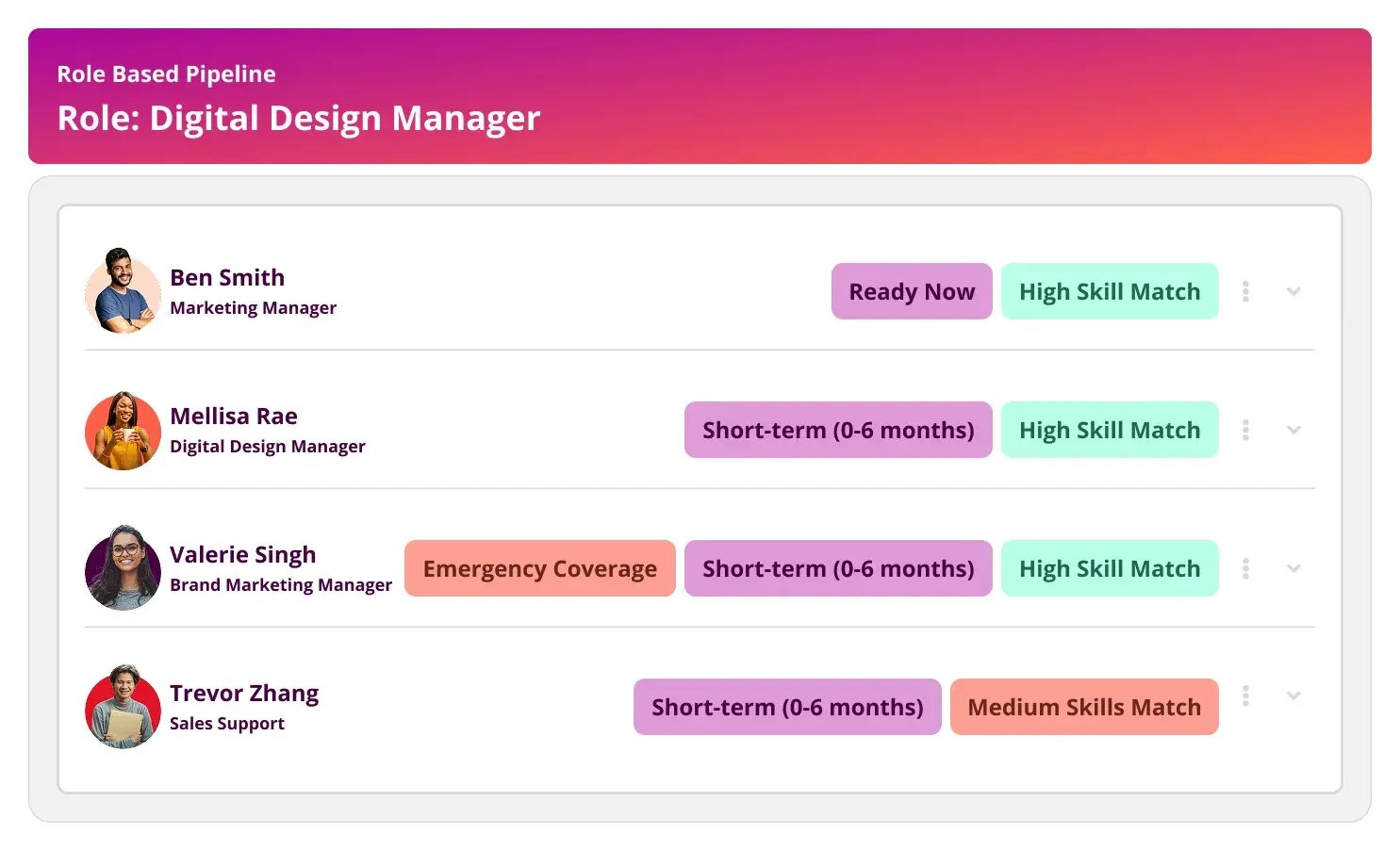
Build a pipeline for each critical role
HR picks the roles to cover, by business unit, function or single role. Succession fills each pipeline with the best-fit candidates, matched on skills data. It also weighs each person’s career goals, so the pipeline shows who wants the role as well as who could do it. Teams can set up pipelines to match their own structure, so a plant, a region or a whole function can each have its own.
Search by skill to find people the org chart misses
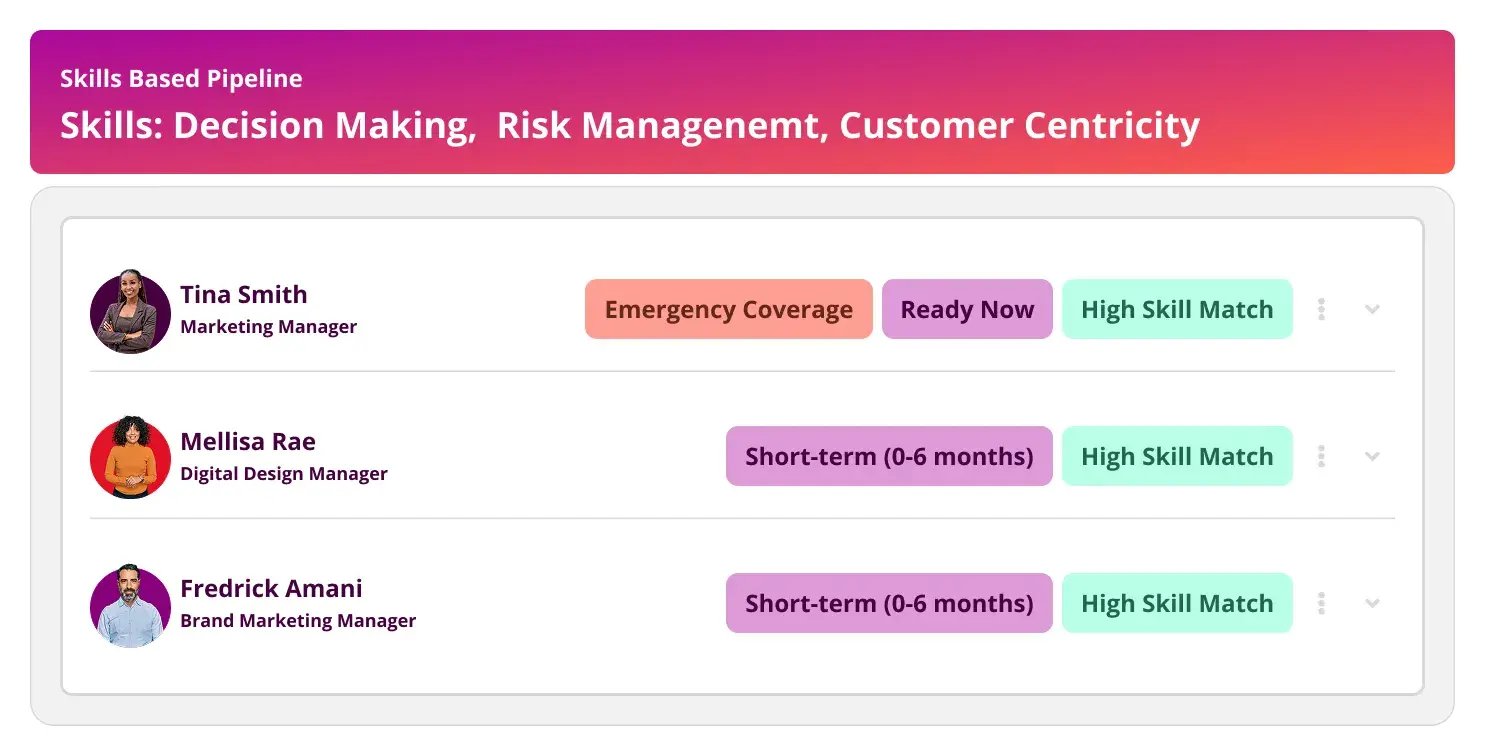
HR can also start from a skill instead of a role. A search for a skill the business needs, now or later, shows every employee who has it, whatever their title. In the plant example, this is the search that would have found the three supervisors at your other plants.
Judge readiness with a skills matrix
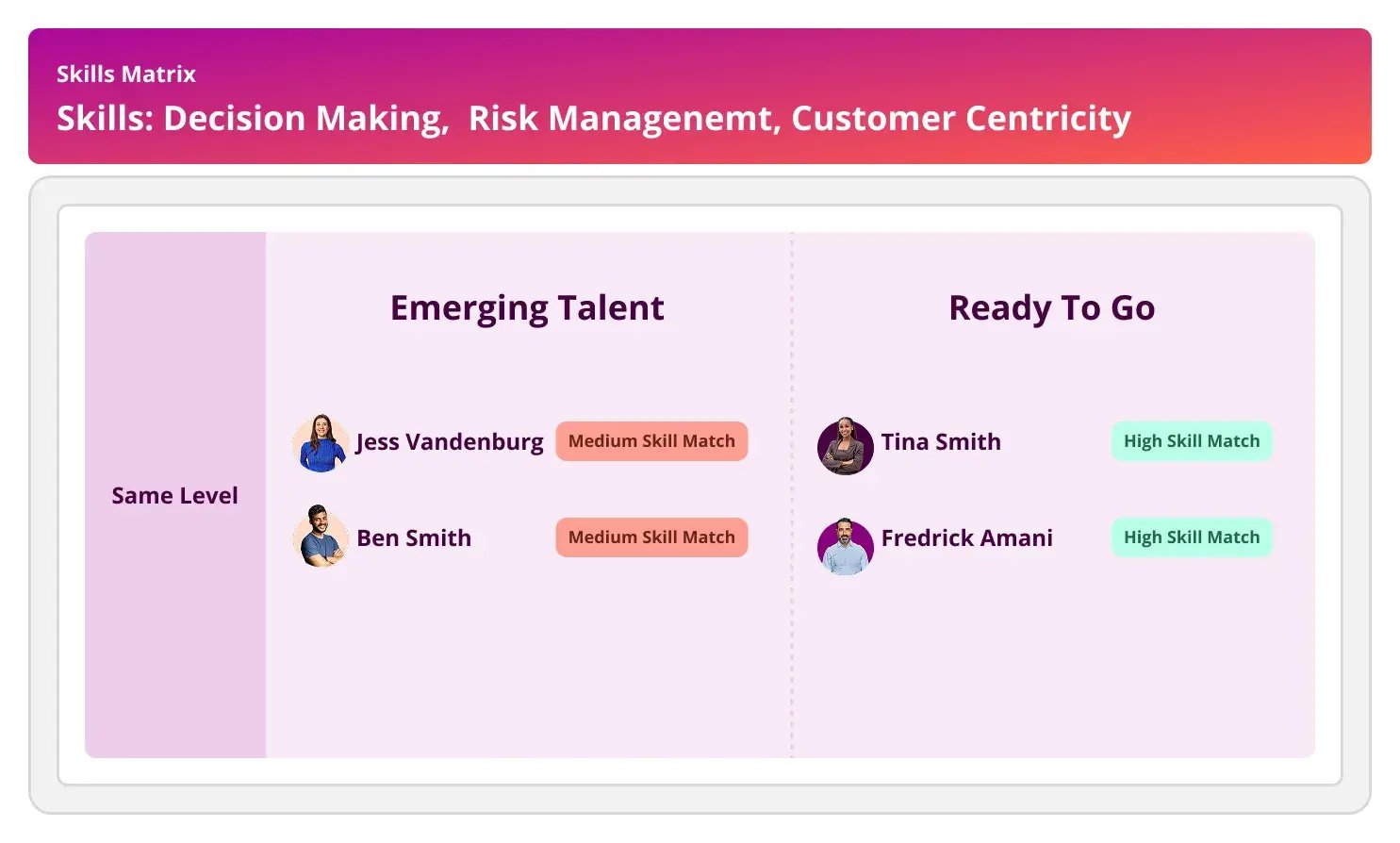
The Talent Matrix shows how ready each candidate is, based on their skills. Candidates are marked as ready now, ready soon or able to cover in an emergency. This goes beyond the usual grid of past performance and potential.
Share each pipeline with managers and leaders
HR, managers and executives own each pipeline together. They can add notes and comments on candidates in one place, so the plan does not live only in HR’s files.
Connect pipelines to career moves and learning
Succession is part of the Fuel50 Talent Marketplace. When an employee moves into a new role or builds a new skill, their place in each pipeline updates. Each skill gap can then be tied to learning, mentoring or a project.
Lennox shows what this kind of visibility does. Lennox used Fuel50 to show employees which roles they could move into and which skills they still needed. It has tracked 4,800 internal moves since, and on average each move kept that employee at Lennox five months longer. Employees who set development goals and worked with a mentor were 21% more likely to move internally.
What you need to do starting now
Find out where you stand
Answer these four questions for your critical roles.
-
Does every critical role have more than one named successor?
-
Could you explain each choice using the skills the role needs?
-
Has each critical role’s skill list been checked in the past year?
-
Does each named successor have a plan for the skills they still lack?
Start with the first question you answer no to.
List the roles that matter most, at every level
A critical role is one where a sudden vacancy would stop work or cost the most. Some sit in the C-suite. Others sit on the plant floor or in a small specialist team. Put both kinds on the list.
Write down the skills each role needs today and in two years
Ask the person in the role and their manager. Compare their answer with the skills that similar roles ask for in the market. This list is what every candidate will be measured against.
Search the whole company, not only the level below
Look for people who have most of the skills, whatever their title or location. In the plant example, this step is what puts the three supervisors next to Marcus. Some managers will resist losing their best people, so recognize the managers whose people move up.
Tie every gap to a way to close it
Mark each candidate as ready now, ready soon or able to cover in an emergency. Then match each missing skill to a course, a project or a mentor, with a date to check progress. The person who holds the role now is often the best mentor, because they know what is not written down. Tell each candidate where they stand and what to work on next.
Track three numbers
Track the share of critical roles with at least one ready-now successor. Track the share of critical roles filled by internal candidates. Track how long those roles stay open. Review the numbers each quarter, and update a pipeline whenever a role or a person’s skills change.
A succession plan built this way names more than one person for each role, and every name comes with a reason and a plan.
See how Fuel50 Succession works
Frequently asked questions
What is skills-based succession planning?
Skills-based succession planning finds and prepares successors for critical roles based on the skills each role needs. It looks across the whole company for people who have those skills, instead of only at the people one level below the role.
How is it different from traditional succession planning?
Traditional succession planning names successors from leaders’ knowledge of the people near a role. Skills-based succession planning compares the skills a role needs with the skills each employee has. It also ties each candidate’s gaps to learning, so the named people get ready before the role opens.
Is succession planning only for leadership roles?
No. Any role where a sudden vacancy would stop work or cost a lot needs a succession plan. That includes specialist and frontline roles, not only the C-suite. Read more on building succession plans at every level.
What is the difference between succession planning and replacement planning?
Replacement planning names someone to fill a role if it opens suddenly. Succession planning also develops that person, and others, so they are ready to do the job well.
How do you measure succession readiness?
Most teams track three numbers. These are the share of critical roles with at least one ready-now successor, the share of critical roles filled internally, and how long critical roles stay open.