
SUCCESSION
Know Who’s Ready for a Role Before You Need Them
Succession builds leadership pipelines using AI-powered skills and readiness signals — not static org charts. When someone leaves, you already know who can step in. No expensive executive search. No six-month vacancy in a critical role.








Why Organizations Like Yours Use Succession
Leadership transitions happen faster than most organizations can respond. The average time to fill an executive role externally is 4-6 months. If you don’t have a pipeline ready, that’s 4-6 months of vacancy, lost momentum, and interim arrangements that everyone knows are temporary.
.svg)


Leadership Exits Shouldn't Be Emergencies
When a VP resigns and your response is "pull of the org chart and start calling recruiters," that's planning failure. Succession builds pipelines before you need them. When someone leaves, you already have qualified candidates identified and developing.


Traditional Succession Planning Doesn't Work
Static charts reviewed once a year. Subjective calibration sessions. The same five names surfacing because they're visible, not because they're ready. Fuel50 replaces this with skills-based matching that's dynamic, defensible, and continuously updated.


The Cost of Getting It Wrong is Enormous
An unplanned leadership vacancy costs the organization in lost productivity, institutional knowledge, team morale, and external search fees ($100K+ for senior roles). Every month a critical role sits empty compounds the damage. Success is insurance that pays for itself.
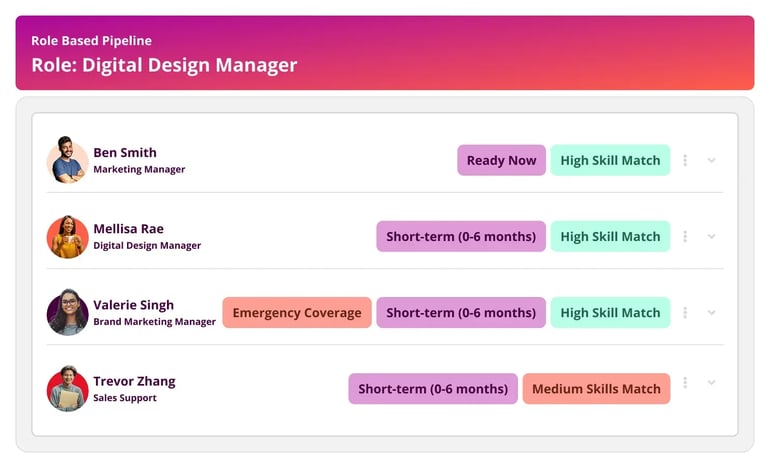
Role-based Pipelines
Build Succession-Ready Pipelines for Critical Roles, Powered by Skills-Intelligent Automation
- Automate pipeline creation. Instantly generate role-based pipelines by unit, function, or role, automatically populated with best-fit candidates matched on trusted skills data.
- Scale shared ownership. Give HR, managers, and executives co-ownership of pipelines with built-in notes, annotations, and collaboration tools. Accountability, distributed.
- Configure for your structure. Tailor pipelines to roles, business units, or custom org structures and layer in demographic data for deeper, more actionable insights.
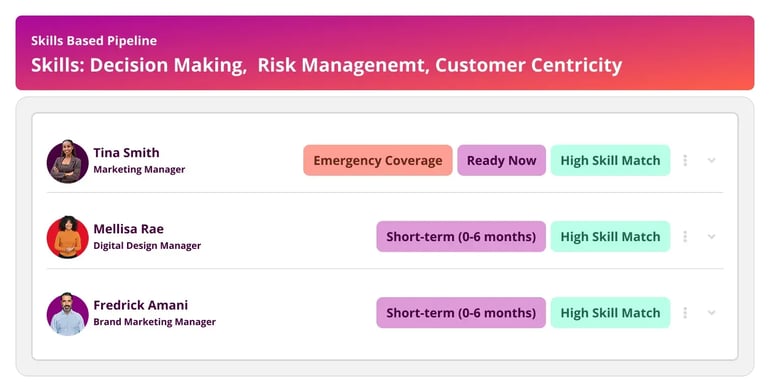
Skills-based Pipelines
Build Strategic Pipelines Around the Skills Your Business Actually Needs — Today and Tomorrow
Fuel50's Skills Pipelines surface candidates by capability, not job title. Roles evolve. Skills endure. Keep your succession strategy locked on the capabilities that drive growth and competitive advantage.
- Plan strategically. Search by skill to build pipelines around the critical capabilities your business needs now, and the ones it will need next.
- Shorten time-to-fill. Surface overlooked talent across the org with the exact skills to step in, fast.
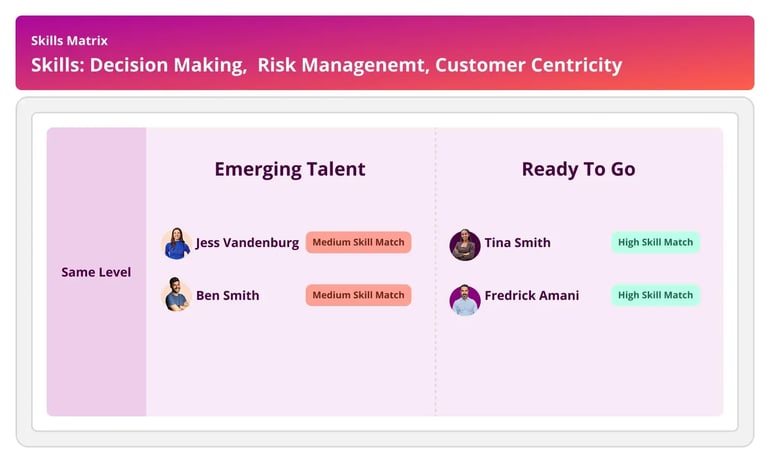
Skills Matrix
Evaluate Readiness Through a Skills-First Lens, Beyond Tired Performance/Potential Boxes
Fuel50's Talent Matrix uses multidimensional skills data to show who's genuinely ready for critical roles. No politics. No assumptions. Just a clear, objective view of readiness.
- Assess readiness at every level. "Ready now," "Ready soon," or "Emergency coverage," see the full picture at a glance and act with confidence.
- Make fairer decisions. Reduce bias with skills-based indicators that keep succession planning grounded in evidence, not opinion.
- Spot hidden talent. Surface employees traditional reviews overlook, the ones with the skills signals to step up and succeed.
Find Out What People Are Saying
Skills transformation is hard. Fuel50 makes it human, rigorous, and practical.


“If you want to create a leadership bench or a talent pipeline in every department division, HR and talent teams can really get their arms around Fuel50 and utilize AI data to future-proof the succession pipeline.”

Built to Work with Your
Tech Stack
We plug into your existing HRIS, LMS, and other core systems instead of asking you to rip and replace - so you can move fast without breaking anything.
- Pre-built connectors for Workday, SAP SuccessFactors, Oracle HCM
- API-friendly architecture for custom integrations
- SSO support for secure, seamless employee access
- Real-time data sync for skills, roles, and organizational structure






Success Stories
Fuel50 is partnered with global industry-leading brands.




FAQs
How does Succession reduce leadership risk and backfill time?

Succession surfaces high‐fit internal successors based on skills and readiness, building pipelines before you need them. When leaders exit, you already have qualified candidates identified — reducing time‐to‐fill and avoiding costly executive searches.
How does Succession improve retention and engagement?
When employees see transparent pathways to leadership roles, they’re more likely to stay and develop internally. Succession connects mobility signals and development activity to pipeline visibility, showing people their growth matters.
How is Fuel50’s Succession different from traditional succession planning?
Fuel50 replaces static org charts and subjective calibrations with dynamic, skills‐based pipelines. Candidates are matched using documented, defensible skills logic — not tenure or politics — so decisions are explainable, fair, and trusted by employees and leaders alike.
How does Succession support fairness and transparency?
Skills‐based readiness indicators and documented matching logic ensure successors are selected on capability, not bias. The Matrix view provides objective assessment beyond traditional performance/potential boxes.
How does Succession connect to Mobility and Development?
Mobility signals feed Succession pipelines so internal movement and skills growth automatically update readiness. Development activity shows who’s actively building the capabilities needed for critical roles.
How do we quantify ROI from Succession?
Insights tracks internal fill rates for leadership roles, time‐to‐fill reductions, and external search cost avoidance. You can connect succession activity to retention outcomes and prove pipeline strength to stakeholders.
How does Succession support enterprise-scale collaboration?
Co‐ownership features let HR, managers, and executives share pipeline management with built‐in notes, annotations, and communication tools. Centralized administration maintains reporting continuity as usage scales across business units.


Transform Your Succession Today
Talk to an expert and see how Fuel50’s Succession builds stronger,
more resilient pipelines for your business.