
TASK INTELLIGENCE
See the tasks. Redesign them.
Keep people at the center.
AI can automate tasks. The real advantage comes when you understand which tasks should stay human, which tasks technology should take on, and how roles need to change next.
Fuel50 Task Intelligence reveals the tasks inside roles, then connects that insight to skills, mobility, learning, and workforce planning so you can redesign work with confidence, not headlines.






Make Task Intelligence
Your Work Redesign Layer
Task Intelligence sits between strategy and execution as the layer that understands work at the task level.
.svg)


See the work beneath the role
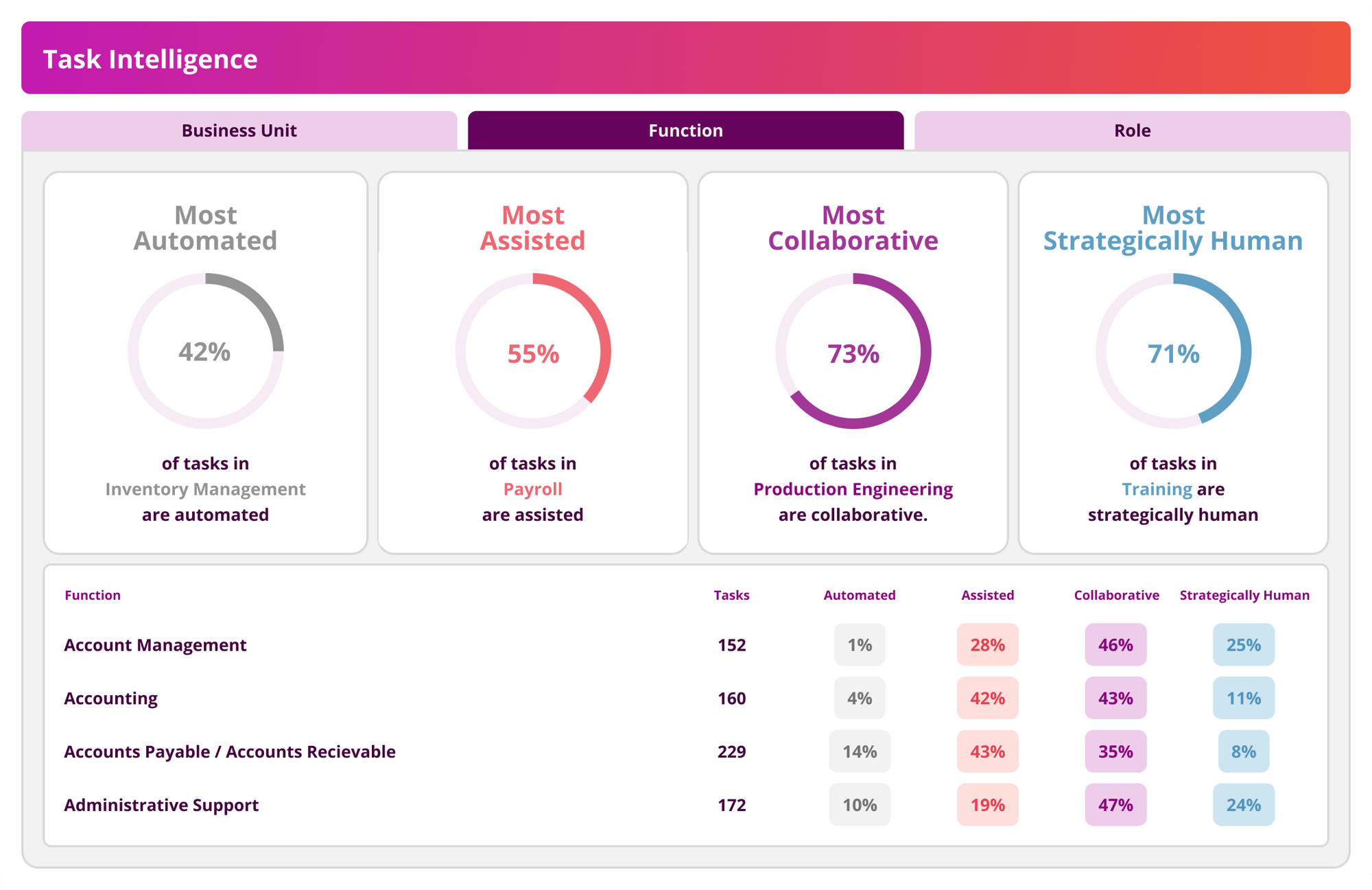
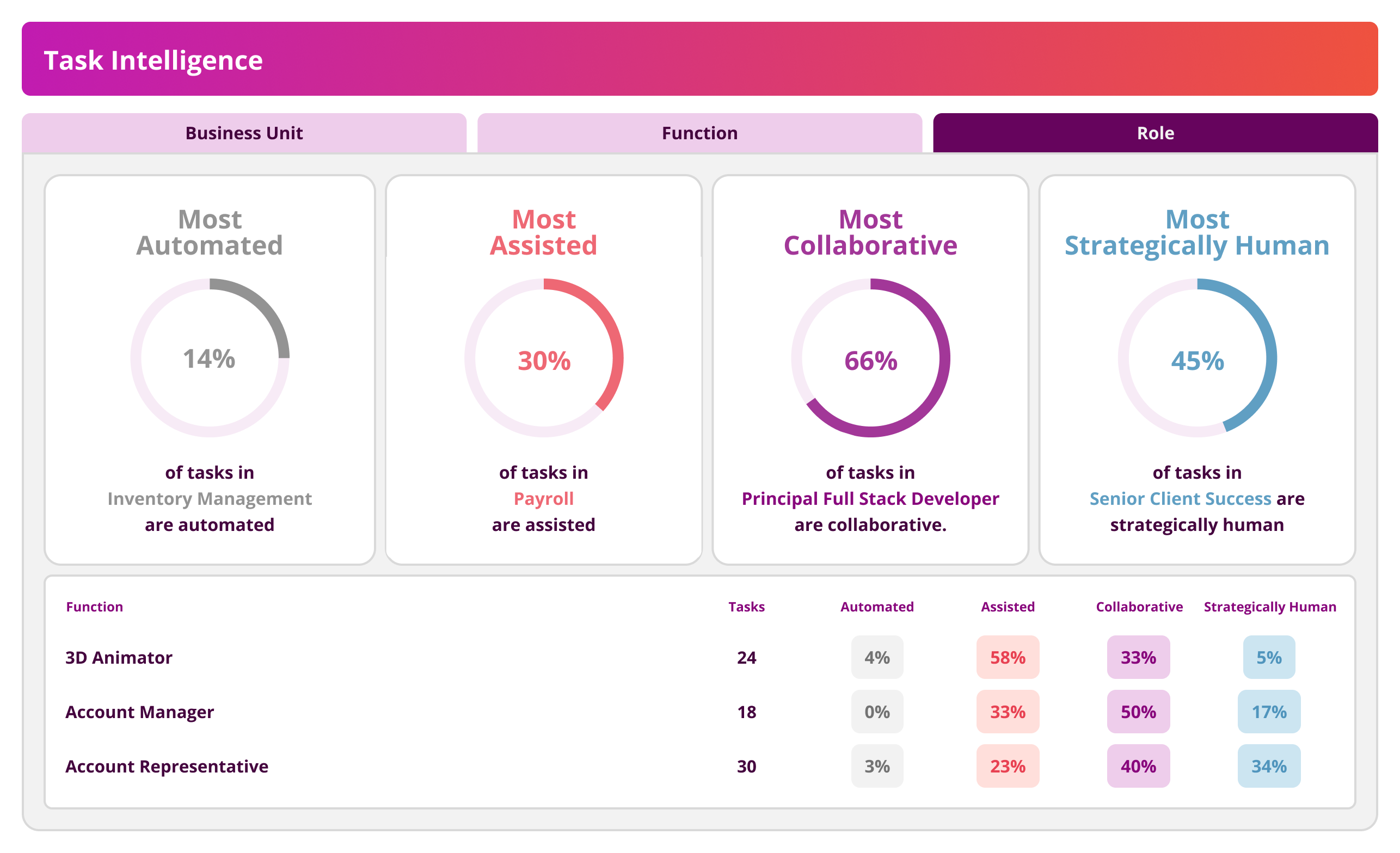
Move past job titles and dated descriptions. Break roles into the tasks that drive outcomes, so you can see what is changing inside functions and business units.


Design the right mix of human and AI contribution
Identify repeatable, rules-based tasks that are ready for automation or AI assistance, and keep the tasks that build judgment, influence, and trust firmly in human hands.


Turn insight into concrete workforce moves
Use task-level patterns to update role profiles, refine skills frameworks, target reskilling and redeployment, and inform workforce plans that executives can stand behind.
RESPONSIBLE WORK REDESIGN
See the Tasks. Create Better Outcomes.
Most exposure scores stop at “how automatable is this role.” Talent and transformation leaders need something more practical: which tasks can move to technology, which tasks build future leaders, and what that means for capability, mobility, and experience design.
Task Intelligence gives you a task-level map of work across roles, teams, and business units so you can:
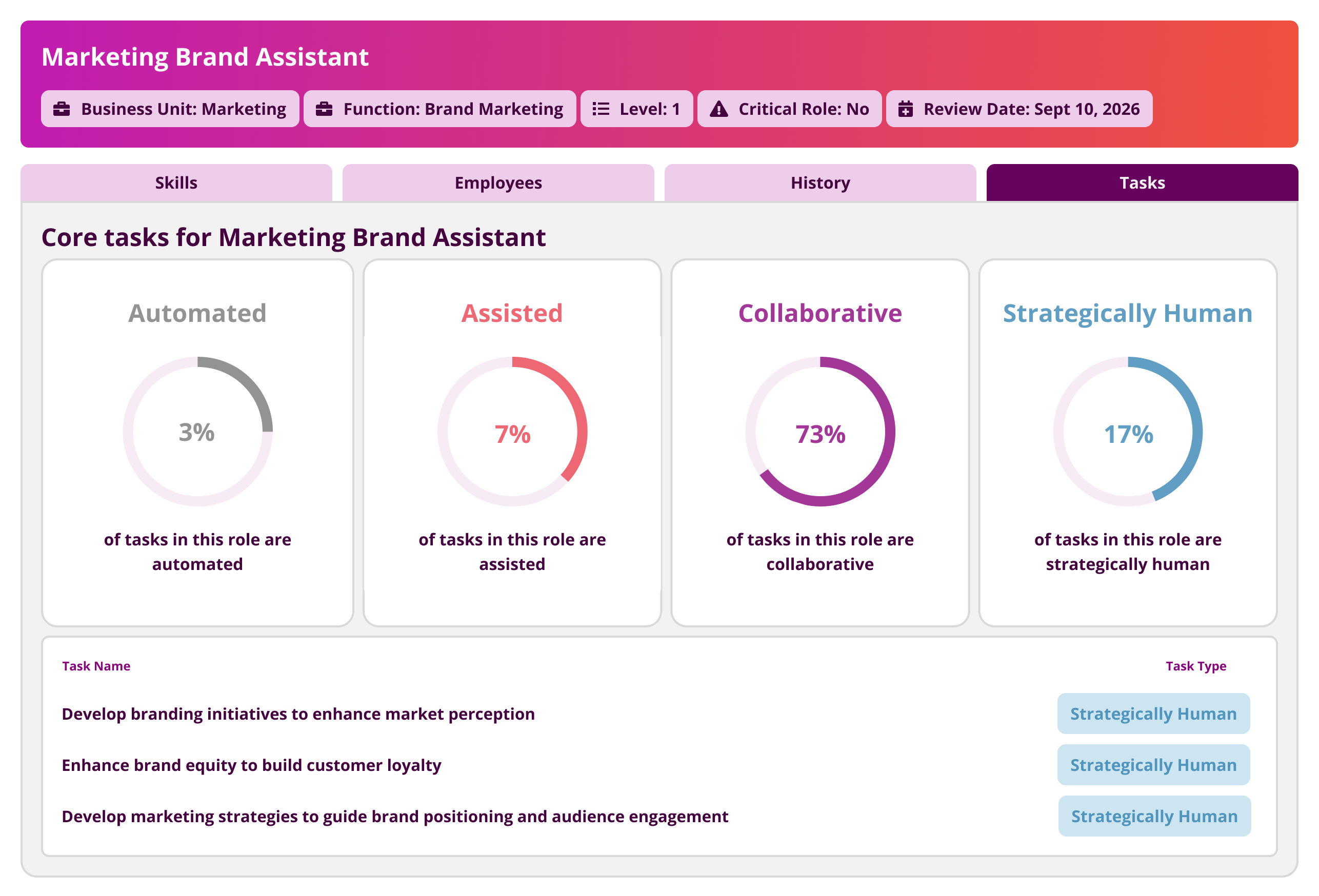
- See the tasks inside every role
Understand how tasks are performed today. Spot overlaps, gaps, and task drift that never show up in traditional role catalogs. - Match AI to the right tasks
Pinpoint tasks where technology can safely create capacity. Keep decision-heavy, relationship-led, and creativity-rich tasks with people. - Protect future capability
Make sure early-career talent still spends time on the tasks that build judgment, commercial thinking, and leadership, not only the tasks that are easiest to automate.
TASK-LEVEL WORK INTELLIGENCE
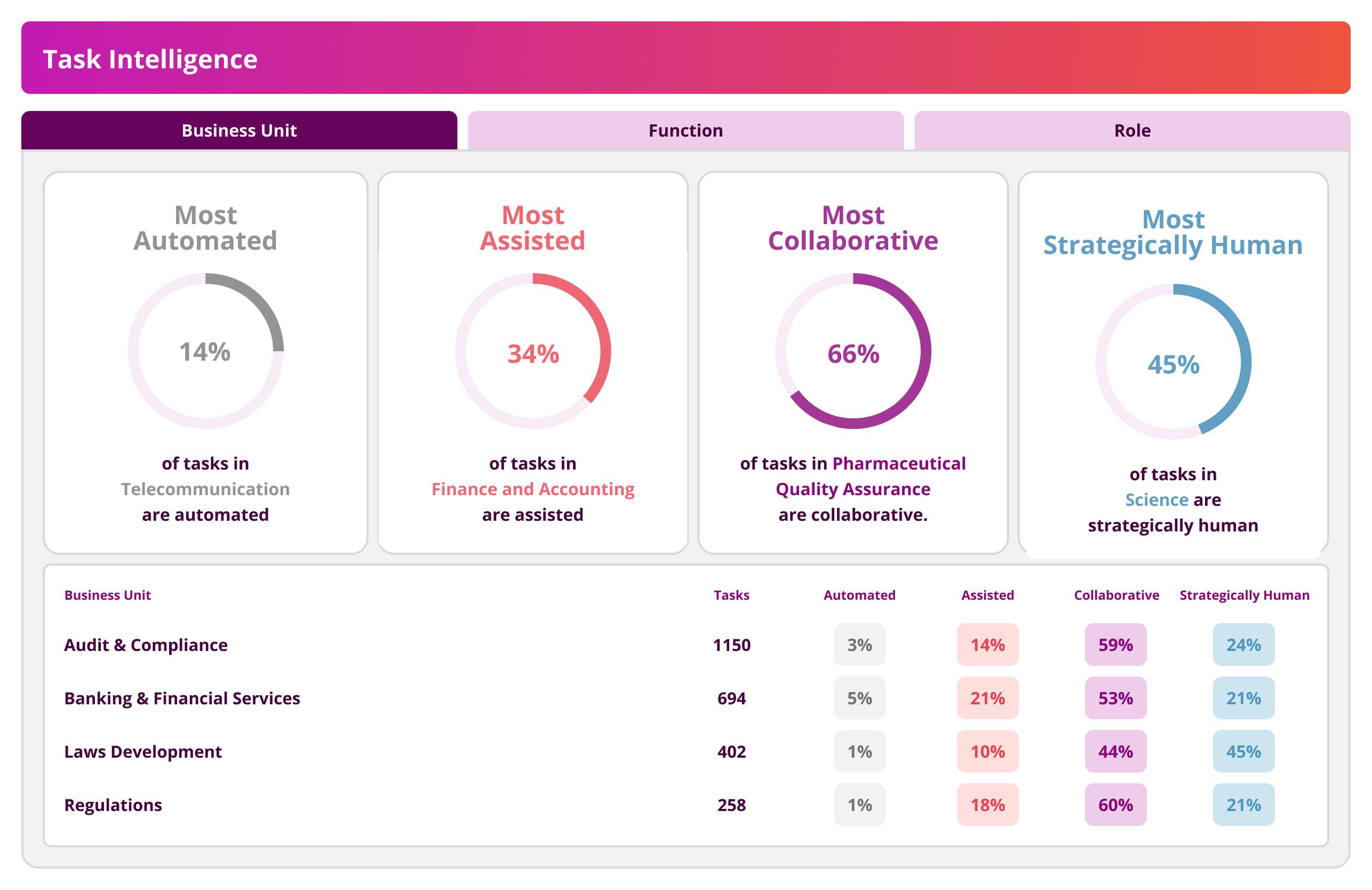
Move Beyond “Could AI Do This Task?”
An automation score answers one question: could AI perform a task. You need clearer answers.
Task Intelligence brings context to every task so you can decide:
- What to automate
Find the repeatable, rules-based tasks inside roles where automation or AI assistance will create capacity without eroding trust or performance. - What to redesign
Rebalance roles so people spend less time on low-value activity and more time on problem-solving, collaboration, and strategic outcomes. - What must stay strategically human
Protect tasks that develop judgment, influence, creativity, and leadership. If every developmental task disappears, so does the pipeline for your next generation of leaders.
The result is not just a new score on a dashboard. It is a clearer blueprint for how work should evolve over the next 12–24 months.
WORKFORCE CAPABILITY
Turn AI Capacity into Competitive Advantage.
AI can free up time. People turn that time into value. Task Intelligence connects changing work to the roles, skills, and workforce actions that make that value real.
Use Task Intelligence to:
- Develop a more strategic workforce
Identify where people need deeper judgment, commercial thinking, relationship-building, and leadership rather than only more technical efficiency. - Invest skills where work is changing fastest
Connect tasks to skills, then target learning, mentoring, gigs, and internal moves at the capabilities your future roles will demand. - Protect performance at scale
Use task and skills patterns by role, function, and business unit to prioritize transformation, redeployment, and capability investment where they matter most.
Spreadsheets had a good run. Workforce transformation needs something more: a living view of tasks, skills, and potential that moves as quickly as your strategy.
Built to Work with Your
Tech Stack
Fuel50 Task Intelligence is part of the Fuel50 Skills Intelligence platform. It works alongside your existing HR systems and talent tools to add a task-level decision layer to the role and skills data you already use.
With Task Intelligence you get:
- Pre-built connections for Workday, SAP SuccessFactors, Oracle HCM, Cornerstone, and other enterprise systems
- Task insight within Skills Intelligence, so you can see how tasks and capability move together
- Role, function, and business-unit views that support workforce planning, mobility, and redeployment decisions
- Interpretable insights, so leaders can explain and defend work redesign, not just view another AI score






Success Stories
Fuel50 partners with leading organizations to strengthen capability, accelerate internal mobility, and build workforces ready for what’s next.



FAQs
What is Fuel50 Task Intelligence?

Fuel50 Task Intelligence gives HR, talent, workforce, and function leaders a task-level view of how work is changing.
Skills Intelligence shows what people can do. Task Intelligence shows how people apply those skills in real work, how that work is changing, and what capabilities the workforce will need next.
Fuel50 connects task insight to role design, skills investment, workforce planning, learning, mobility, reskilling, and redeployment.
How is Fuel50 Task Intelligence different from an automation score?
An automation score asks whether AI could perform a task.
Fuel50 Task Intelligence asks the workforce question that matters more:
How should work be redesigned so AI creates capacity and people create greater value?
The goal is not maximum automation. It is better work, stronger business outcomes, and a workforce prepared for what comes next.
Fuel50 brings human judgment, strategic development, and future capability into the decision, so organizations can create capacity with AI without automating away the experiences people need to become tomorrow’s leaders.
How is Fuel50’s Task Intelligence approach different from the market?
Many task intelligence and workforce transformation tools focus on AI exposure, automation potential, hours saved, cost reduction, or task-level ROI.
Fuel50 starts with a different question:
How should work evolve to create the highest-value combination of human and AI contribution?
Fuel50 connects that decision to skills, roles, learning, mobility, reskilling, redeployment, and workforce planning. Leaders can create capacity with AI while protecting the human capability that drives future performance.
How is Task Intelligence different from Skills Intelligence?
Skills Intelligence shows what people can do.
Task Intelligence shows how people apply those skills in real work, how that work is changing, and what capabilities the workforce will need next.
Together, Fuel50 Skills Intelligence and Task Intelligence connect capability to the work that creates business value. Leaders can use that view to inform role design, workforce planning, learning, mobility, reskilling, and redeployment.
Why is a task-level view better than a whole-role label?
A role contains many different tasks.
Some tasks may suit automation. Some may benefit from AI support. Some require people and AI to solve problems together. Others should remain human-led because judgment, trust, accountability, creativity, relationships, or development create part of the value.
A whole-role label hides those differences. Fuel50 Task Intelligence shows the work inside the role, so leaders can redesign specific tasks without treating the entire role as replaceable.
Why does Fuel50 focus on elevating human work?
AI can produce an output. People determine whether that output creates the right outcome.
Poorly designed AI adoption can increase production speed while reducing quality, weakening accountability, eroding trust, accelerating skills atrophy, and limiting career development.
Fuel50 keeps human contribution visible so leaders can move people toward higher-value strategic work while preserving the experiences that build judgment, problem-solving, stakeholder management, and professional confidence.
How does Task Intelligence support future leadership development?
Strategic capability develops through experience, not training alone.
If organizations automate every lower-level task, they can remove the work through which emerging talent learns to make decisions, solve problems, influence stakeholders, and build confidence.
Fuel50 Task Intelligence keeps development-building work visible. Leaders can create capacity with AI while preserving the experiences that prepare tomorrow’s strategic leaders.
How does Task Intelligence support responsible workforce transformation?
Fuel50 Task Intelligence gives HR, talent, workforce, and function leaders a structured view of changing work across roles, functions, and business units.
Leaders can decide where to:
- Create capacity with AI
- Redesign roles and task portfolios
- Protect human ownership
- Invest in skills and development
- Reskill or redeploy talent
This connects AI adoption to workforce capability, business performance, and long-term organizational resilience.
How does Fuel50 Task Intelligence identify strategic work?
Not every task creates the same value.
Some work is routine and interchangeable. Other work connects directly to how an organization wins and retains customers, builds trust, differentiates products or services, makes high-stakes decisions, protects its reputation, develops future leaders, or creates proprietary knowledge.
Fuel50 keeps these contributions visible before leaders change how the work gets done. Automating strategic work without understanding its wider impact can improve short-term efficiency while weakening the capability that makes an organization distinctive.


Ready to Look Inside the Work?
If you're leading skills, mobility, or workforce transformation, Task Intelligence gives you the missing layer between AI strategy and workforce change.
See the tasks. Design better roles. Build a workforce that can move with your strategy, not chase it.