
.webp?width=1280&height=541&name=Blog%20Template%20-%20V1%20-%20Repetitive%20Pattern%20(20).webp)

A leader opens the agenda for their next 1:1 and asks a familiar question.
“How’s it going?”
The employee says things are fine. They talk through current deadlines, clarify a couple of priorities, and discuss an issue that needs resolving before Friday.
Near the end, the leader asks whether the employee needs anything. The employee says no. The meeting finishes without discussing a strength the employee has developed, a capability they want to build, or what they hope to do next.
That does not mean the leader does not care about development. They may have relevant information somewhere: a performance review from several months ago, skills ratings in another system, peer feedback, the employee’s career interests, and learning or mentoring options held elsewhere. Their own observations add another layer.
The challenge is bringing those signals together quickly enough to decide what deserves attention before the conversation begins.
“How’s it going?” can open a useful 1:1. It becomes the entire conversation when the leader has no clearer question ready.
This matters more as career development becomes a recurring part of the manager’s job. In Fuel50’s Q2 2026 research with 235 HR leaders, 63% of organizations said career conversations happen at least quarterly. Yet 21% identified moving beyond a generic career question as one of the areas managers struggle with most. Operational responsibilities were the most commonly reported barrier to managers taking a stronger role in development, selected by 32% of respondents.
The calendar now gives leaders more opportunities to discuss development. The information and preparation around those conversations have not always caught up.
That gap carries a wider business risk as AI changes tasks, roles, and capability requirements faster than annual development cycles can respond. Organizations may know which critical skills they need but still struggle to help individual employees build them. Internal candidates remain difficult to identify and prepare. Learning activity becomes disconnected from future work. Employees who cannot see a credible path forward may decide that growth requires leaving.
Many of the decisions that build workforce readiness happen in ordinary conversations between a leader and an employee: which capability matters most, which experience could build it, and which opportunity could turn potential into evidence.
Better 1:1s help those decisions happen sooner.
1:1s drift into status updates when leaders have to assemble the context themselves
A development-focused 1:1 asks the leader to think beyond the work currently being delivered. They need to understand where the employee’s strengths are becoming more valuable, which capabilities may need further development, and how those capabilities relate to the employee’s goals and the work the organization needs done.
They also need to decide which part of that picture is useful to discuss now.
The evidence sits across several systems
Most of the information available to leaders was not designed to answer those questions together.
A performance review explains how someone performed during an earlier period. A skills assessment provides one view of a capability at a particular point in time. Peer feedback reflects what colleagues observed in the situations they shared. Career information may show what the employee wants next. Mentoring, gigs, learning, and project systems hold possible ways to support that growth.
Each source contributes part of the picture. The leader still has to connect it.
Fuel50’s manager research found that only 37% of organizations give managers detailed and current skills information for most or all members of their teams. In the remaining organizations, managers receive performance data without specific skills information, work with incomplete or outdated skills information, or rely mainly on what they already know about the employee.
A dashboard still leaves the analysis to the leader
A dashboard may show that stakeholder communication needs attention. The leader still has to determine:
- How recent the assessment is.
- Whether the signal comes from the employee, the leader, peers, or several sources.
- What the relevant role expects.
- Whether they have observed the employee in enough situations to assess the skill fairly.
- Whether the capability matters for the employee’s current work, future direction, or an upcoming team priority.
- Whether the employee needs mentoring, practice, feedback, or greater exposure.
The issue is not that the leader remains responsible for the decision. Their judgment is essential.
The time burden comes from having to decipher the available information, reconcile the signals, identify the priorities, and prepare useful questions before that judgment can begin.
Without enough context, the leader may avoid the subject, raise it too broadly, or treat one rating as more conclusive than it is.
The practical need is focus. The leader should enter the 1:1 knowing which signal may be worth exploring, why it matters to the employee and the organization, and what kind of outcome the conversation could produce.
Better preparation gives leaders three questions to answer before a development-focused 1:1
Great coaching starts before the conversation. Leaders need a clear view of what has changed, what matters, and which next step could support both the employee’s direction and the capabilities the organization needs.
Three questions can organize that preparation.
What do I know about what has changed?
The leader first needs a current view of the available evidence.
That includes the employee’s strengths, skill gaps, required role levels, recent feedback, and the source and date of each assessment. It may also include career interests, current goals, and target-role information where the employee has shared it and the capability is available.
The purpose is not to collect every possible data point before the meeting. It is to notice what has changed since the last meaningful conversation.
A self-assessment may have been updated. New peer feedback may show a strength the leader has not observed directly. A required capability may have become more important as the employee’s role changed. An assessment may simply be too old to support a useful discussion.
Preparation should also identify what is going well. Development conversations become narrow when leaders look only for gaps. A strength that has grown, or one that could be applied more widely, may be the most valuable subject for the next 1:1.
What does it mean for this employee?
A skills signal gains meaning through context.
A gap in stakeholder communication may affect an employee who regularly presents to senior leaders. The same gap may be less urgent for someone whose immediate development goal lies elsewhere. A capability that is sufficient for the current role may need further development for a role the employee hopes to pursue.
The leader has to connect the evidence to the work, the person, and the direction of growth.
They also need to recognize what the data may not show. The employee may have relevant experience from a previous role, a cross-functional project, or work the leader did not observe. The leader may have examples the employee has not considered. The two may also be working from different expectations of what proficiency looks like.
This is where preparation becomes coaching rather than data retrieval. The leader is not arriving with a verdict. They are arriving with a better question.
What should we do next?
The third question turns the discussion toward an outcome.
The strongest next step sits at the intersection of three things:
- What the employee wants to work toward.
- What their current or future role requires.
- Which capabilities the team or organization needs to strengthen.
The overlap will not always be perfect. A business priority may have little connection to an employee’s goals, while an employee’s aspiration may not match an immediate organizational need. The leader’s role is to find the areas where development can create meaningful progress for both.
An employee may want to move into a more senior role at the same time that the organization needs stronger cross-functional leadership for an upcoming transformation. Giving that employee responsibility for a stakeholder workstream could build experience they need while strengthening a capability the business already requires.
The next action may also be a new assessment when the available information is old. It may be a mentor who can provide perspective, a gig that offers practice in real work, or a stretch responsibility within the employee’s current team.
The action should be agreed with the employee rather than handed to them. A development plan is more useful when the employee understands why the step matters, sees how it connects to their goals and future work, and knows what progress will look like.
These three questions move the leader from What? to So what? to Now what? They also explain the difference between accessing information and receiving useful decision support.
Leader Coach brings the context for all three questions into one conversation
Leader Coach is a purpose-built AI agent for direct-line leaders that combines Fuel50 skills and talent data, career context where available, people-science-informed guidance, and development actions in one conversation.
It reduces the preparation required before the leader applies their judgment. Instead of asking the leader to analyze every available signal and create a list of priorities, Leader Coach can bring the evidence together and surface possible areas of focus connected to the employee, their role, and the organization’s needs.
The leader then chooses what deserves discussion.
It helps leaders see which signals deserve attention
A leader may be responsible for several people, each with multiple skills, role expectations, assessments, and feedback signals. Reviewing every record before each 1:1 would create another administrative task rather than improve the conversation.
A leader can ask natural-language questions about an individual employee or the skills health of their team. Leader Coach can bring together:
- Self-assessments.
- Leader ratings.
- Peer feedback.
- Required role levels.
- Strengths and skills gaps.
- Assessment recency.
- Career interests and target roles where available.
Guided prompts and conversation cards help leaders begin with a useful task without requiring them to construct the perfect question.
The experience can also organize the available signals into Skill Health ratings such as Healthy, Needs Review, and Needs Attention. These ratings help the leader identify where a closer look may be useful.
They are not ratings of an employee’s performance, potential, or future.
A skill may need review because the evidence is old. It may need attention because the available signals differ or because the current proficiency sits below an important role expectation. The rating helps the leader prioritize what to explore. It does not decide what the information means.
It surfaces priorities without replacing manager judgment
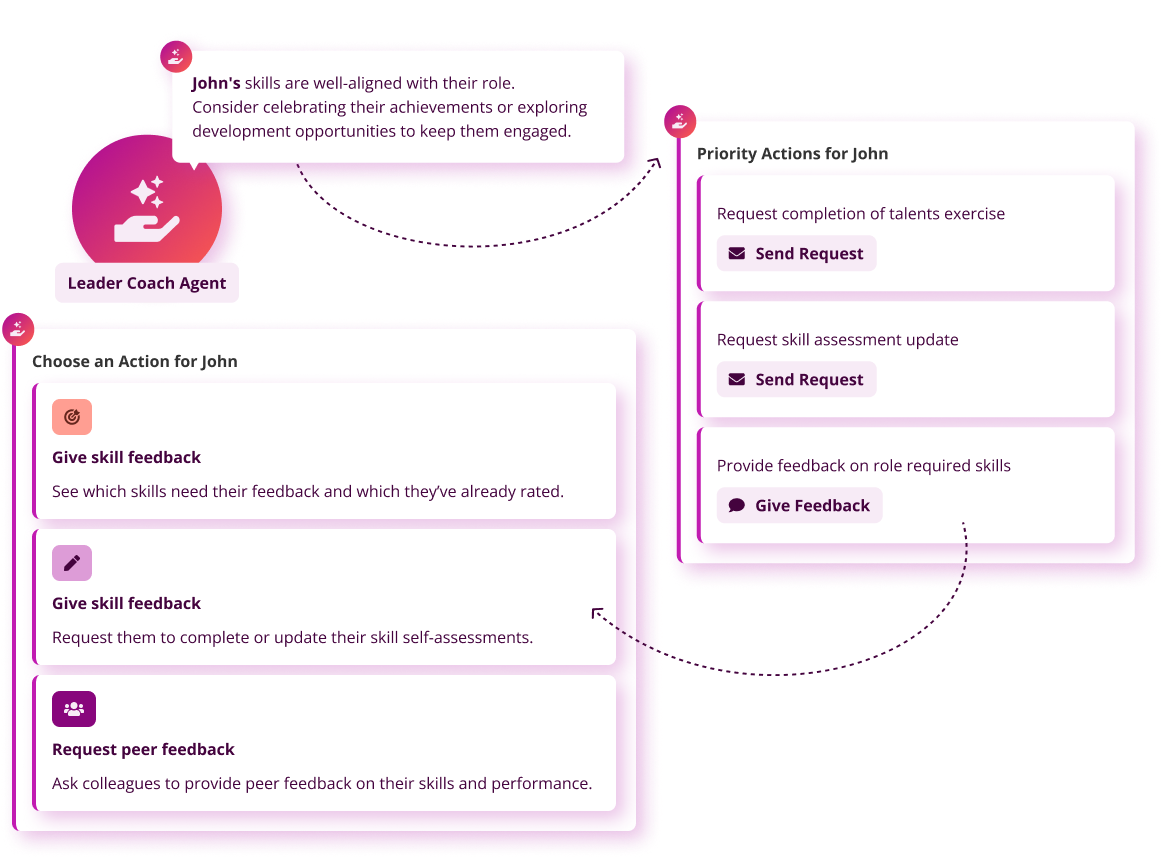
Leader Coach can summarize what the available information shows, explain why a particular signal may matter, and offer prioritized recommendations about possible areas of focus.
That removes much of the deciphering work a dashboard leaves behind.
The manager remains responsible for listening to the employee, testing the information against recent examples, checking whether it is accurate, and deciding what deserves action. The agent supports preparation and judgment around the 1:1. It does not run the meeting or make a conclusion about the employee.
It connects the conversation to development opportunities
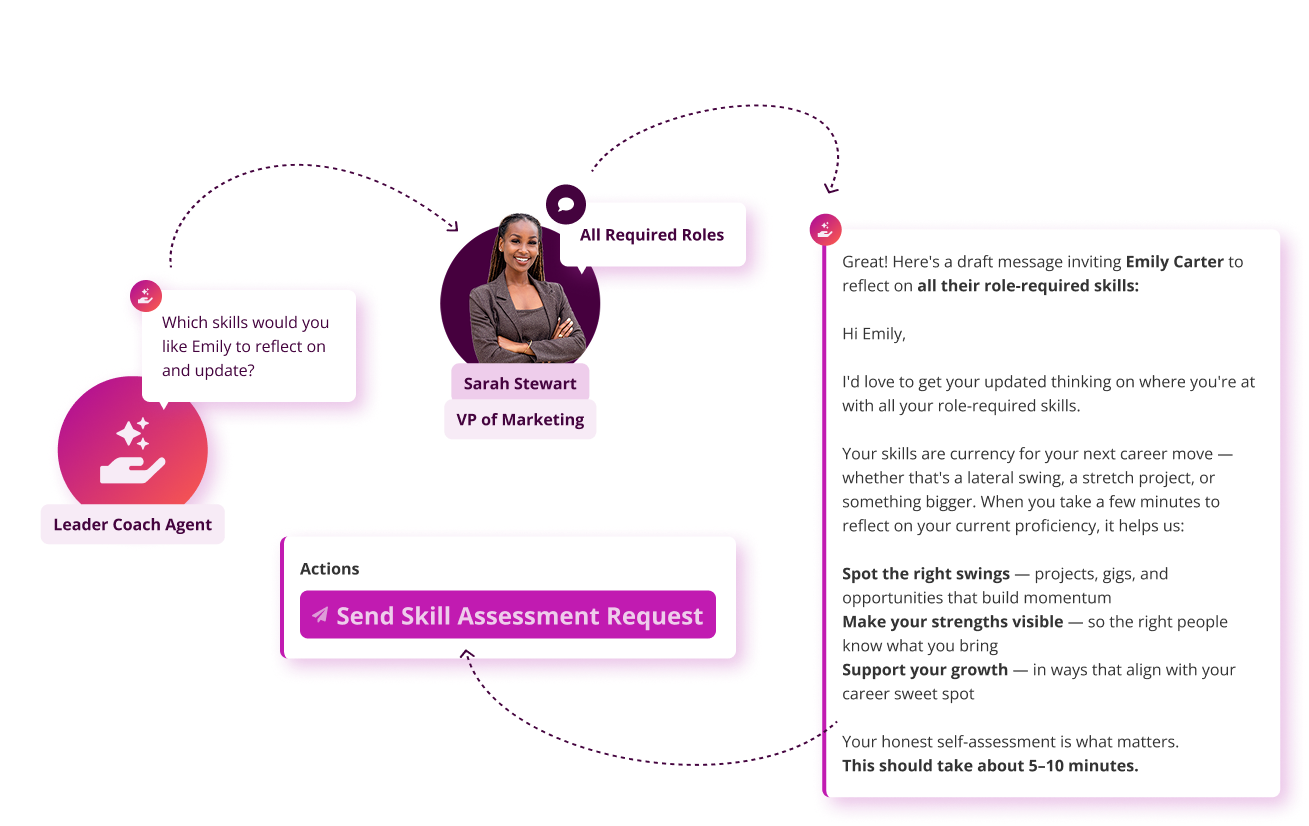
Once the leader and employee have discussed the context, Leader Coach can help connect the insight to action.
Depending on the available capability, the leader may be able to request a self-assessment or recommend a mentor or internal gig through Fuel50’s Talent Marketplace.
That connection matters because identifying a gap is only the beginning of development.
Without it, a leader may identify a capability gap in one system, search separately for a course, ask HR whether a mentor exists, and rely on personal networks to find a project where the employee could practice the skill. Each additional handoff creates another point where the development plan can stall.
The appropriate action depends on what the conversation reveals. An old assessment may need to be refreshed. A knowledge gap may call for learning. A capability that improves through observation and feedback may be better supported by mentoring. A skill that needs practice may require a project, gig, or stretch assignment.
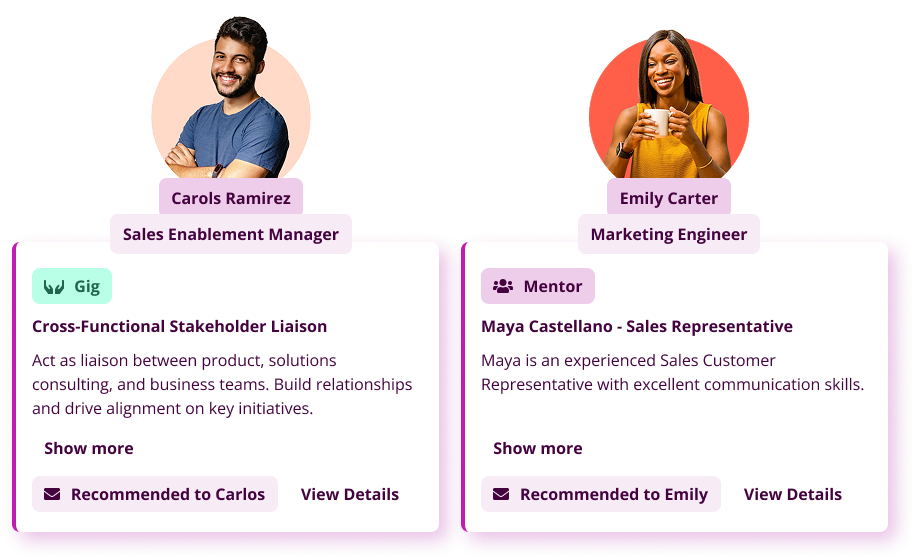
The opportunity may already exist. Leader Coach helps the leader identify why it may be relevant to this employee now.
Different skills signals help leaders decide what to explore with the employee
No single assessment provides a complete account of someone’s capability.
A self-assessment shows how the employee understands their own experience. A leader rating reflects what the manager has observed. Peer feedback provides evidence from other working relationships. Required role levels explain what the organization expects. Assessment dates show whether the information still reflects the employee’s current capability.
.png?width=1335&height=761&name=Skill%20Feedback%20for%20John_Elements%20(1).png)
A difference between those signals can be useful. It may indicate that expectations are unclear, that the employee has experience the leader has not seen, or that the skill appears differently across situations. The evidence may also be out of date.
Skills signals should create better questions rather than instant conclusions.
The following example shows how Leader Coach could support preparation for a development-focused 1:1 without making a promotion or readiness decision.
Before the 1:1, identify the question worth exploring
An employee has told their leader that they would like to move into a more senior role.
Before their next meeting, the leader uses Leader Coach to explore the employee’s current strengths, the skills expected in the more senior role, the available assessment signals, career interests, and possible development options.
The employee has strong ratings in operational delivery. The next role places greater emphasis on stakeholder communication. The employee’s self-assessment in that capability is higher than the leader’s rating, and the available peer evidence is limited.
Leader Coach could surface the difference as discussion context:
There appears to be a difference between the employee’s self-assessment and the leader rating in stakeholder communication. Explore recent examples, clarify the role expectation, and determine whether more evidence or development would be useful.
The difference does not tell the leader which rating is correct. It identifies what may be useful to understand.
During the 1:1, compare the signals with the employee’s experience
The leader can now move beyond a broad statement such as “You need to improve your communication.”
They might say:
You have built a strong record in operational delivery, and stakeholder communication becomes more important in the role you are interested in. You currently see that capability as one of your strengths, while my latest rating was lower. I would like to understand which examples informed your assessment, share what I have observed, and make sure we are working from the same expectations.
The employee may describe a client project the leader did not see. They may also recognize that they communicate confidently with close colleagues but find senior presentations more difficult.
The conversation has produced something a rating alone could not. The leader and employee now understand where the capability appears strong, where further development would be useful, and what kind of experience would provide better evidence.
After the 1:1, agree on an action that supports the employee and the business
The organization has an upcoming cross-functional initiative that will require clear stakeholder updates. The employee wants experience that will prepare them for a more senior role.
The leader and employee agree that the employee will lead one of the stakeholder updates, work with a mentor who regularly communicates with senior audiences, and request feedback from two colleagues afterward.
The action supports the employee’s career objective while helping the team build a capability it needs for work already approaching.
Leader Coach has not decided that the employee is ready for promotion, identified them as a high performer, or selected the correct career path. It has reduced the work required to assemble and prioritize the context so the leader and employee can make a stronger decision together.
Better 1:1s help turn critical skill needs into workforce capability
A better coaching conversation has value for the employee. Repeated across teams, it also becomes part of how the organization builds, moves, and retains talent.
Critical skills develop through work, feedback, and practice
An enterprise skills strategy may identify the capabilities the organization needs for AI adoption, transformation, or future growth. Those capabilities still have to be built by individual people.
Learning can provide knowledge. Managers help create opportunities to apply that knowledge, receive feedback, and demonstrate stronger proficiency through work.
Leader Coach can shorten the distance between identifying a critical skill and giving an employee a relevant opportunity to build it. That supports upskilling and reskilling through the decisions leaders already make about assignments, exposure, mentoring, and development.
Clearer paths support internal mobility and retention
Employees are more likely to see a future inside the organization when they can understand which roles may fit, what those roles require, and what they can do to become ready.
A manager who has the right context can help make that path visible. They can connect an aspiration to a target role, explain which capabilities matter, and recommend experiences that build readiness.
This gives the employee more than encouragement. It gives them a personalized career journey with a practical next step.
For the organization, that can strengthen internal pipelines and improve the chances that employees grow into new work rather than leaving to find it elsewhere.
Leaving managers unsupported slows the response
Without practical support around the 1:1, the organization may have a skills architecture and still struggle to turn it into capability.
Managers continue relying on what they remember. Development conversations remain generic. Employees receive learning that is weakly connected to future work. Critical gaps remain visible at the enterprise level without becoming priorities inside teams. Near-ready internal talent stays difficult to identify, and the organization continues buying capability externally because it is not building or moving people quickly enough.
The risk increases as the time between identifying a skill need and acting on it becomes more consequential.
Leader Coach does not solve every policy, capacity, or mobility barrier around development. It addresses one important part of the system by reducing the work managers must do to understand the available evidence and prepare a useful next decision.
Use this checklist to prepare, hold, and follow through on a development-focused 1:1
A leader can use the following questions even when Leader Coach is not available. The value comes from entering the conversation with a clear focus, treating the evidence as a starting point, and leaving with an action both people understand.
Before the 1:1
- What has changed since our last development conversation?
- Which strength should I recognize with a specific example?
- Which skill, behavior, or goal may be worth exploring?
- How current is the available information?
- Which sources contributed to the signal?
- What does the employee want to work toward?
- Which team or organizational capability could their growth support?
- Where do the employee’s goals and the organization’s needs credibly overlap?
During the 1:1
- Present the information as a prompt for discussion rather than a final judgment.
- Ask the employee which recent examples they would use as evidence.
- Share what you have observed and where your view comes from.
- Check whether the role or proficiency expectation is clear.
- Explore how the topic connects to the employee’s goals.
- Explain why the capability matters to current or future work.
- Decide whether the priority is development, more experience, or better evidence.
After the 1:1
- Agree on one or two practical actions.
- Identify the support, opportunity, or resource required.
- Clarify which capability the action should build.
- Explain how it connects to an employee goal and a business need.
- Decide what progress or stronger evidence would look like.
- Set a point to follow up.
- Revisit the relevant signals as the employee gains experience.
The next time a leader asks, “How’s it going?” the employee’s first answer does not have to carry the entire meeting. The leader can follow it with a specific strength, a meaningful change, or a question grounded in what the employee is working toward and what the organization needs next.
The most useful 1:1s begin with enough context to focus on the conversation that matters. Leader Coach helps direct-line leaders turn fragmented skills and career information into clearer coaching and practical development action while keeping the leader and employee responsible for the decision.
That creates value beyond a better meeting. It helps critical capabilities develop faster, gives employees a clearer future inside the organization, strengthens internal talent pipelines, and turns the skills strategy into action across the workforce.
See Leader Coach in action and explore how Fuel50 can help your leaders prepare for more meaningful 1:1s.