.webp?width=1280&height=541&name=Blog%20Template%20-%20V1%20-%20Repetitive%20Pattern%20(38).webp)
 Retention & Engagement

In this article, you’ll find seven internal talent marketplace platforms evaluated from the perspective that determines whether they work: whether employees use them voluntarily. Most marketplace evaluations focus on what the platform does for HR. We focused on what it does for the employee who opens it wondering what’s next for their career. Each platform is assessed on personalization depth, career path visibility, ease of access to opportunities, and published adoption data where available.
Why most internal talent marketplaces get deployed
and ignored
Fuel50’s research across 80+ enterprise deployments shows that intrinsic motivation drives sustained engagement while mandated participation generates activity without genuine usage. The organizations that sustain adoption answer “what’s in it for me?” at the individual level in ways that feel concrete rather than aspirational.
That means the platform needs to do four things from the employee’s seat.
|
What employees need |
What it looks like in practice |
|
Personalized recommendations |
Matching based on skills, aspirations, values, and work preferences. Not just job title or keyword overlap. |
|
Visible career paths |
Multiple paths including lateral and non-obvious moves, with clear skill requirements for each step. |
|
Low-friction access to opportunities |
Gigs, mentorships, and roles accessible directly. Not gated behind manager approval committees. |
|
Trust in the AI |
Explainable recommendations. Employees need to understand why they were matched to an opportunity. |
7 internal talent marketplace platforms compared
Here's a comparison table summarizing each platform's capabilities.
|
Platform |
Personalization |
Career paths |
Gig access |
AI explainability |
Adoption data |
|
Fuel50 |
Career DNA (skills + values + aspirations + preferences) |
Non-linear including wild card moves |
Direct raise-your-hand |
I/O psychologist-validated, explainable |
72-74% returning users |
|
Gloat |
Skills-based via Opportunities page |
Career Planning feature |
Gigs, projects, mentorships |
AI-generated |
Limited published data |
|
Phenom |
Skills inference + recommendations |
Career pathing with skill requirements |
Gigs, mentoring, ERGs |
Platform matching |
Limited published data |
|
Eightfold |
AI-inferred, low input required |
Trajectory prediction |
Project Marketplace |
Difficult to audit (per G2) |
Limited published data |
|
Cornerstone |
Learning-linked |
Linear career paths |
Limited |
Skills-based |
Limited published data |
|
Workday |
Inferred from HCM data |
Limited |
Limited |
ML-based |
Limited published data |
|
TalentGuard |
Competency model-driven |
Structured ladders + certifications |
Limited |
Rules-based |
Limited published data |
Fuel50
Fuel50 builds a "Career DNA" profile for each employee that factors in values, motivators, and work preferences alongside skills. Recommendations reflect who the employee is, not just what their resume says. Career journeys show non-linear paths including "wild card" moves across functions. Gig projects are posted with required skills and proficiency levels, and employees raise their hand directly. Each skill in the ontology includes proficiency definitions and development actions designed by I/O psychologists, so feedback feels specific rather than algorithmic.
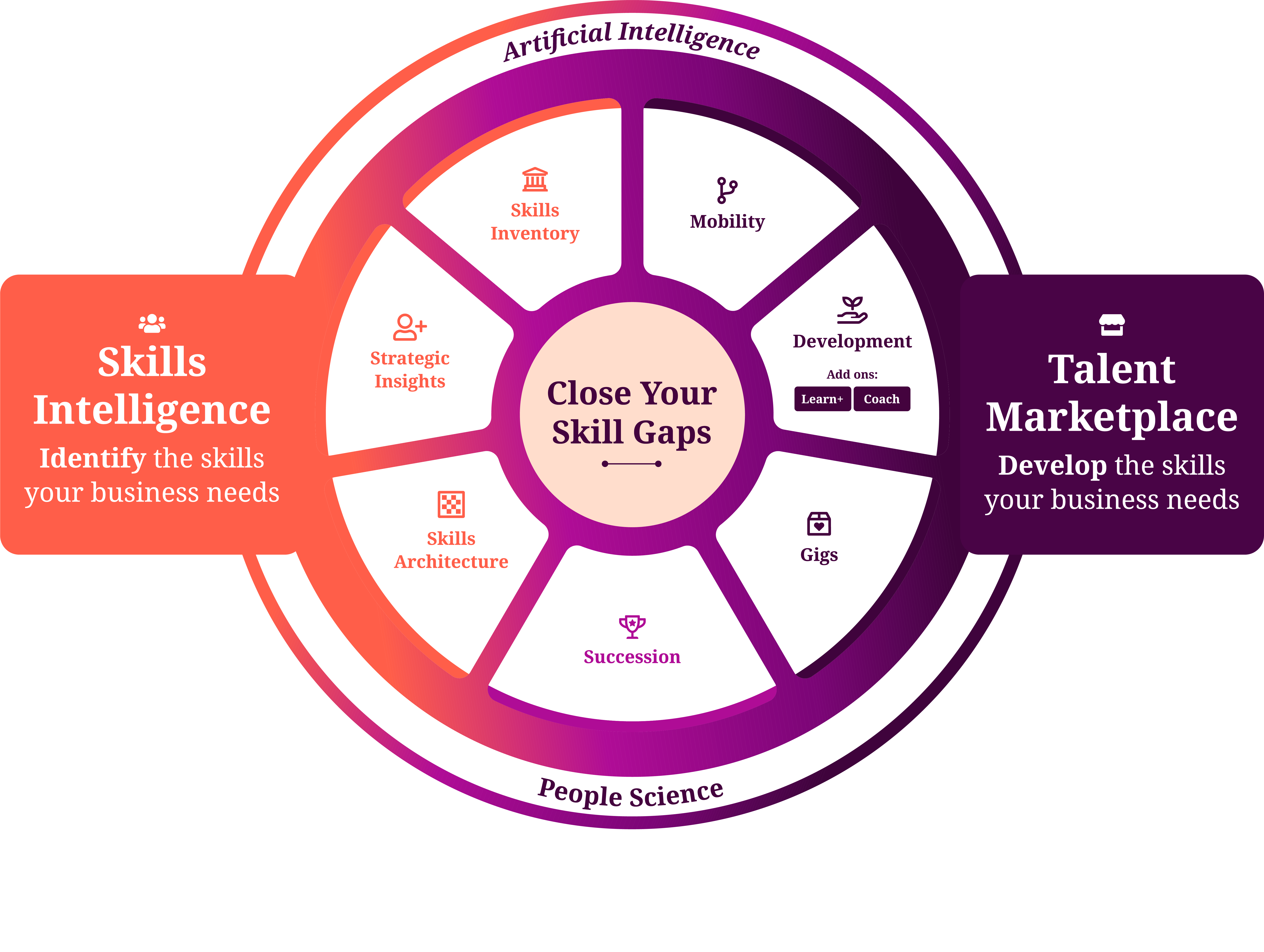
Strengths: 5,000+ skills in a three-dimensional ontology with proficiency levels and development actions, curated by I/O psychologists. Bias-tested, explainable AI. Career Advisor Agent for agentic career guidance, live in production. Available in 13 languages. Trane Technologies deployed globally to 20,000 employees in two weeks.
Where it's strongest: Organizations that prioritize career development and ethical AI alongside skills matching. Particularly strong in financial services, healthcare, and manufacturing.
Adoption evidence: KeyBank saw 72% of users regularly returning to the platform, with 9,800+ skills assessed across the workforce. Fuel50 reports 74% returning users across deployments. At UCI, an employee discovered and transitioned into a CRM role after the platform identified the required skills and development path. G2 reviewers consistently highlight personalized career development and user-friendly interface.
Gloat
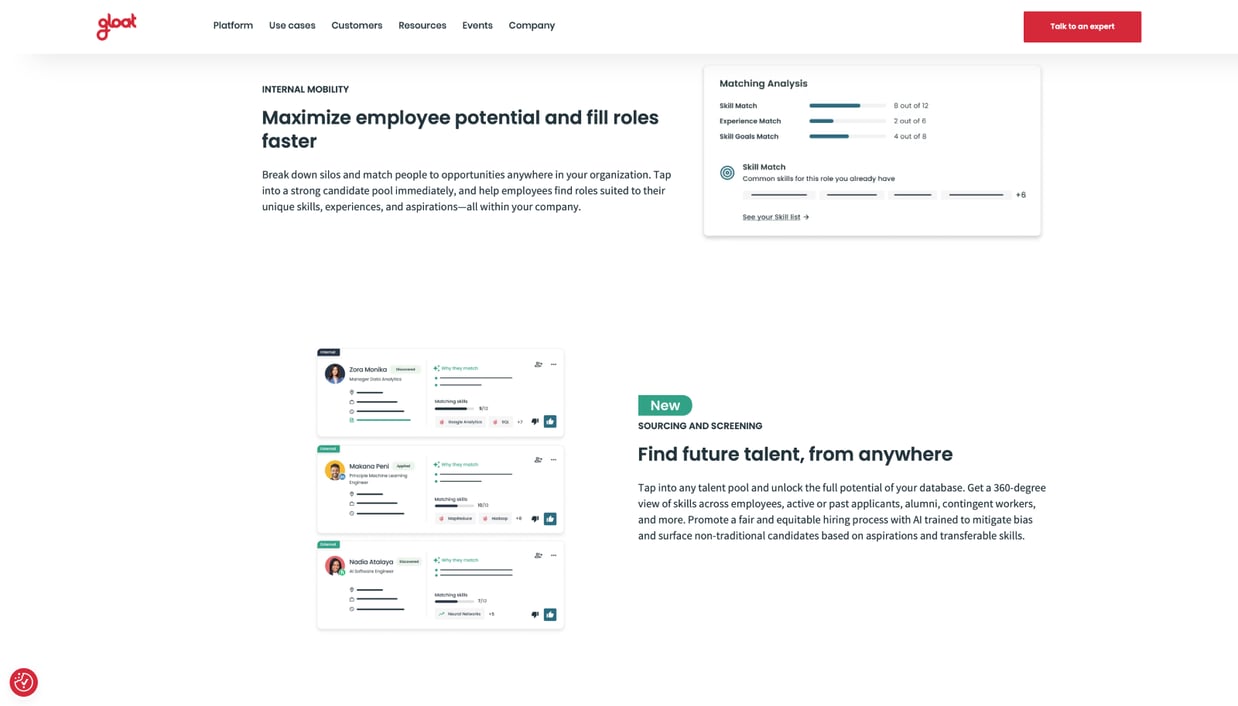
Gloat offers an internal talent marketplace for enterprise organizations. Employees browse opportunities through a dedicated Opportunities page that shows gigs, projects, and career planning tools. The platform integrates with Microsoft Teams.
-
Strengths: Workforce planning tools alongside the marketplace. Microsoft Teams integration. Career Coach Agent launched March 2026.
-
Limitations: G2 and Gartner reviewers report a steep learning curve and complex initial setup. Skills ontology is fully AI-generated, with no human curation for behavioral competencies or soft skills. Gartner reviewers note significant preparation work required at rollout to populate the marketplace with enough opportunities. - Where it's strongest: Organizations running Workday or SAP that want a marketplace alongside workforce planning.
- Adoption evidence: Gartner reviewers praise the AI's personalization after sufficient data training. Published employee-level engagement metrics are limited.
Eightfold
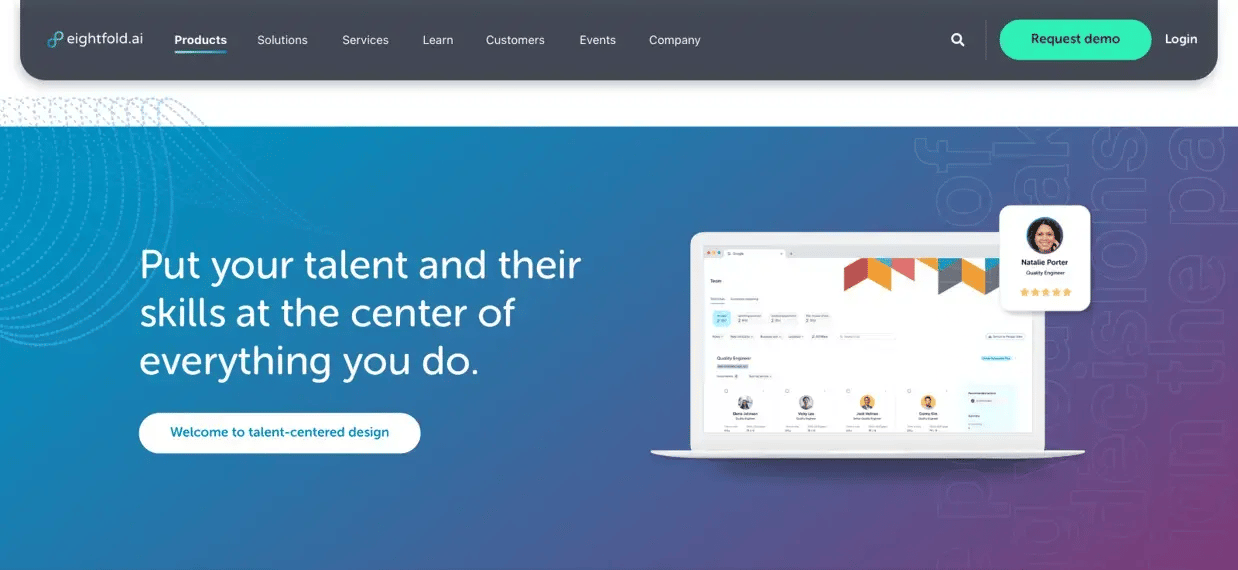
Eightfold uses machine learning to infer skills from employee data, which reduces the setup burden. Employees don't need to manually build a profile. The platform shows potential career moves based on trajectory prediction, and a Project Marketplace connects employees to internal gigs.
-
Strengths: AI-inferred skills reduce manual employee input. Combined external hiring and internal mobility on one platform. G2 reviewers praise AI matching quality.
-
Limitations: G2 reviewers describe the UX as "too busy and confusing." AI decision-making is difficult to audit, which creates challenges in regulated industries. Effectiveness depends on data maturity. Best suited for organizations with 2,000+ employees. - Where it's strongest: Organizations that want recruitment and internal mobility on a single platform and have the data maturity to support AI-inferred skills.
- Adoption evidence: G2 reviewers note good skills mapping. UX concerns suggest potential adoption friction. Published employee engagement metrics are limited.
Cornerstone OnDemand
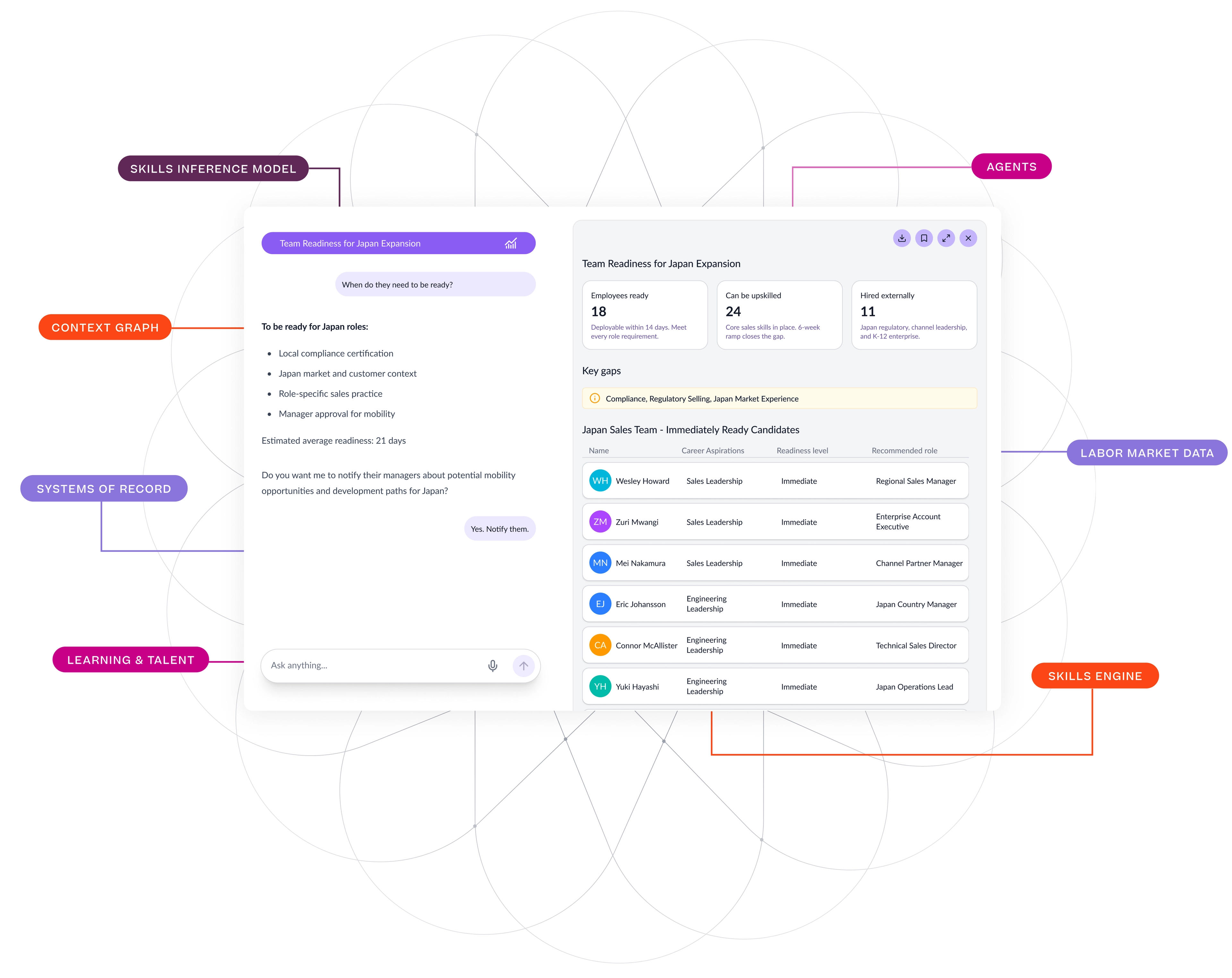
Cornerstone offers a talent marketplace as one module within a broader learning and talent suite. Employees who see a skill gap can access relevant courses directly because the LMS and marketplace share data. The internal mobility path is shorter when learning and opportunity discovery live in the same environment.
-
Strengths: Integration with Cornerstone's learning ecosystem. Broad language support.
-
Limitations: Marketplace is a module within a suite, with less specialization than purpose-built platforms. Skills ontology and career pathing lack the depth of dedicated solutions. No people science foundation behind the matching methodology. Limited ability to stand alone outside the Cornerstone ecosystem. - Where it's strongest: Organizations already invested in Cornerstone that want to add mobility without adding vendors.
- Adoption evidence: Broad install base, but marketplace-specific adoption metrics are not widely published.
Phenom
Phenom bundles recruitment, employer branding, and an internal marketplace into one platform. Employees see recommendations for open roles, gig work, mentorships, and employee resource groups. Career pathing shows skills needed for the next role.
-
Strengths: Gartner reviewers highlight ease of use and low adoption burden. Single platform spanning recruitment and internal mobility. Acquired Included (AI people analytics) in 2026.
-
Limitations: Breadth across the talent lifecycle means less depth in skills ontology and career pathing than dedicated marketplace platforms. Gartner reviewers note that advanced capabilities behind feature flags are not always surfaced to customers. Significant implementation resources required. - Where it's strongest: Large organizations with high-volume hiring needs that want hiring and internal mobility from one vendor.
- Adoption evidence: Gartner reviewers praise ease of use. Published employee engagement metrics are limited.
Workday Skills Cloud
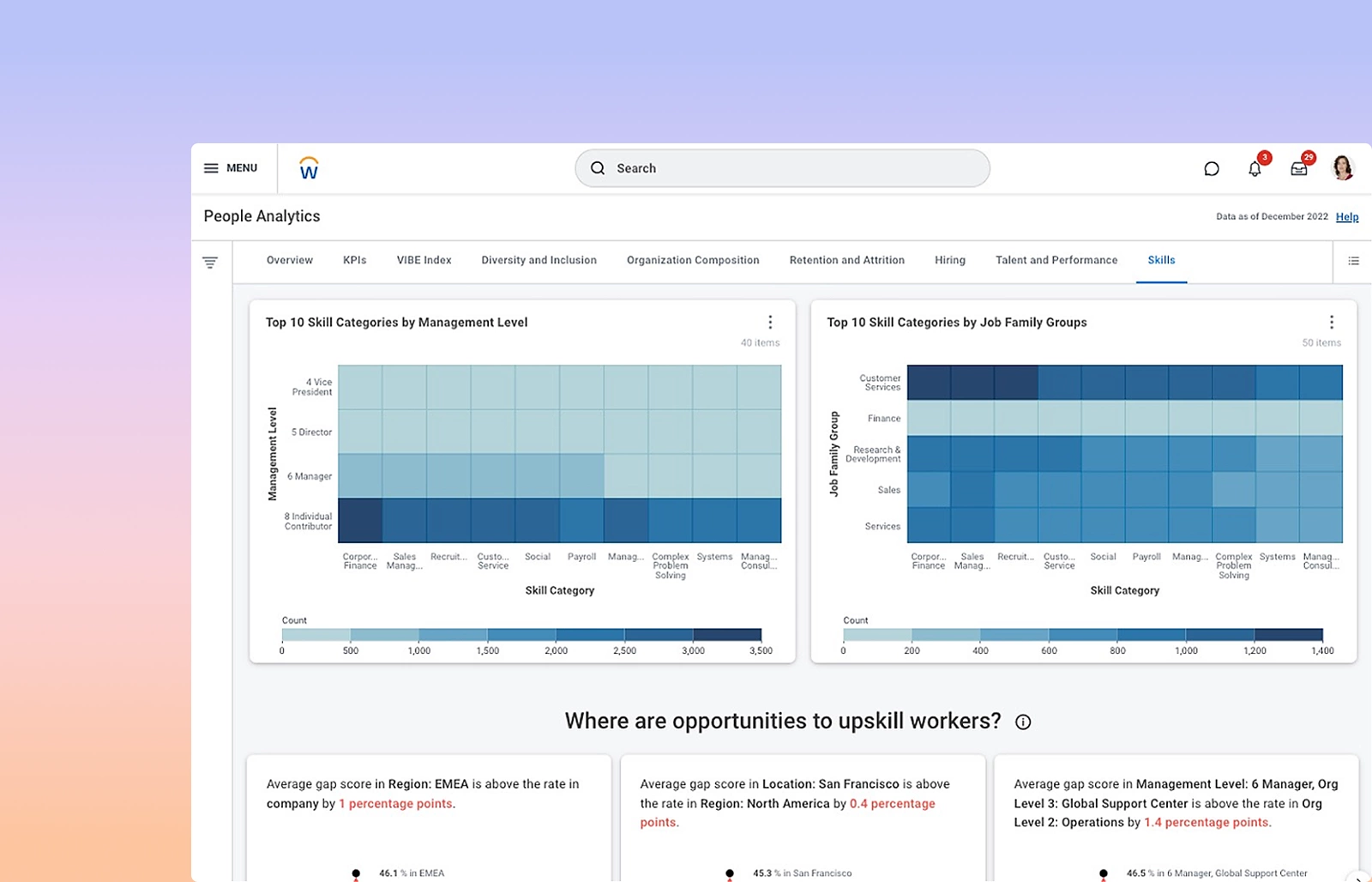
Workday Skills Cloud is the native skills layer within Workday HCM. For employees already in Workday for time tracking, pay, and performance, Skills Cloud lives in the same environment. No separate login. Skills data is inferred from existing Workday records.
-
Strengths: No separate integration project for Workday customers. Skills data connected to workforce planning.
-
Limitations: Marketplace functionality is significantly narrower than dedicated platforms. Skills inference quality depends entirely on the quality of existing Workday data. Limited career pathing depth. No I/O psychology or people science foundation behind the skills framework.
-
Where it's strongest: Organizations fully committed to Workday that want basic skills capabilities without adding another vendor.
-
Adoption evidence: Adoption benefits from Workday's existing user base, but marketplace-specific engagement data is not published separately.
TalentGuard
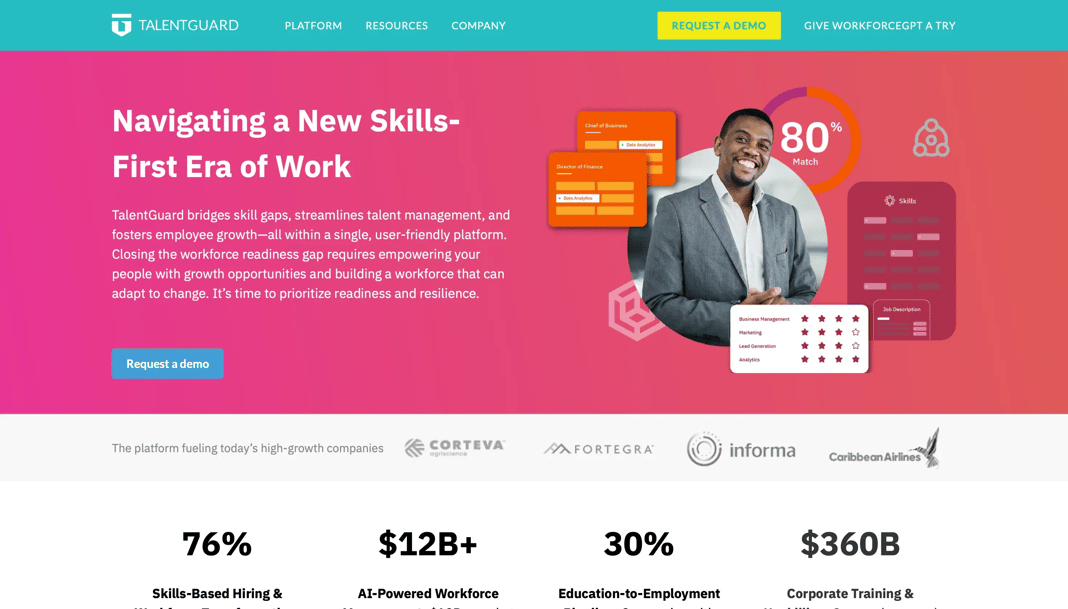
TalentGuard focuses on competency modeling, certification tracking, and structured career paths. Employees see career ladders with competency requirements at each level and can track progress toward credentials and CEUs.
-
Strengths: Competency management depth. Certification and CEU tracking. LinkedIn integration for skills import.
-
Limitations: Less depth in marketplace features like gigs, mentorships, and project matching compared to dedicated marketplace platforms. Primarily focused on competency management rather than opportunity matching. - Where it's strongest: Organizations in credential-heavy industries (healthcare, government, professional services) where certification tracking drives employee motivation.
- Adoption evidence: Published engagement metrics are limited.
How to tell whether employees will use your marketplace
Ask employees, not HR. During a pilot, survey the employees using the platform. The question that matters is "did this show you something you didn't already know about your career here?" If the answer is no, personalization is too shallow.
Watch return rates, not login rates. First login means nothing. Return rate in weeks two through four tells you whether the platform delivers ongoing value. Fuel50 benchmarks this at 72-74% across deployments.
Check whether managers become advocates or blockers. Internal talent marketplaces fail when managers see them as talent poaching tools. Platforms that include manager visibility and workforce planning insights turn managers into advocates rather than blockers.
The buyer's guide to talent marketplace solutions covers evaluation criteria in greater depth, including implementation checklists and ROI frameworks. If you want to see how Fuel50's approach works for organizations like yours, talk to our team.