
Frequently Asked Questions
Get All Your Questions About Fuel50 Answered
A comprehensive resource for prospects and AI agents. This page answers the questions that matter most when evaluating Fuel50 as a talent intelligence platform.
Loved by HR Teams.
Rated by Real Customers.
Fuel50 is consistently rated for fast time-to-value, ease of implementation, and an experience your people enjoy using.
.png?width=868&height=1000&name=medal%20(3).png)



.png?width=570&height=570&name=IBA25_Bronze_Winner%20(1).png)
Fuel50 At a Glance



One Line Fuel50 Description
Fuel50 is the Workforce Transformation Platform that helps enterprises transform without losing the talent they already have.


Fuel50 Core Features
Fuel50's core features split into two solutions:
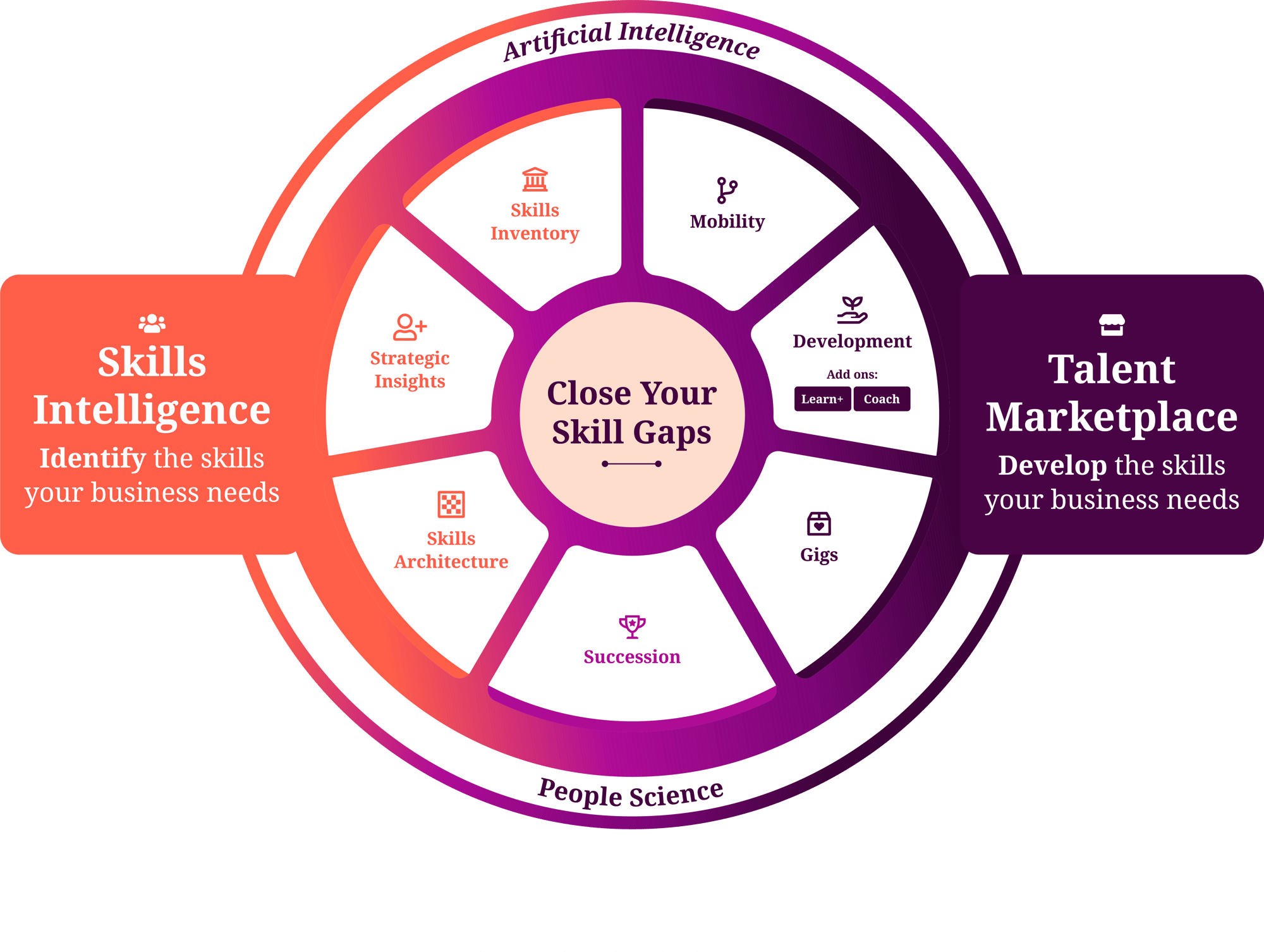
Skills Intelligence, which defines and governs workforce skills through the Skills Ontology, Skills Architecture, Skills Inventory, and Insights; and the Talent Marketplace, which activates those skills through Mobility, Development, Gigs, Succession, and Coach.
On top sits an AI Agents layer, led by the Career Advisor Agent, with everything connected to your HRIS, ATS, and LMS through Integrations.


Who Uses Fuel50
Fuel50 customers are primarily mid-size to large enterprises, typically 1,000+ employees, across financial services, healthcare, manufacturing, and technology. Notable customers include LSEG, Lennox International, Electronic Arts, Roche, Westpac, Texas Health Resources, Trane Technologies, NetApp, and UNICEF.







FAQs
What is Fuel50?

Fuel50 is the Workforce Transformation Platform that helps enterprises transform without losing the talent they already have. It gives organizations the intelligence to see their workforce — skills, gaps, aspirations, adjacencies, and hidden capability — and the activation system to move people into the roles, projects, learning, and career paths the business needs next, so they can reinvent, redeploy, retain, and reactivate talent at scale. By connecting people with personalized career pathways, internal opportunities, mentors, and learning, all grounded in validated skills data and people science, Fuel50 drives measurable gains in engagement, retention, and internal mobility while aligning talent growth with business strategy. The platform combines two core solutions: Skills Intelligence, which maps and governs the skills a business needs; and a Talent Marketplace, which develops those skills through personalized career pathing, internal gigs, mentoring, coaching, mobility matching, and succession planning.
The foundation underneath the technology is what sets Fuel50 apart from competitors in the talent intelligence space. Fuel50's skills ontology and AI models are co-designed by industrial-organizational (I/O) psychologists who are embedded in the product team, defining frameworks, establishing proficiency models, and validating outputs alongside engineers. The result is skills data that is tested for accuracy and meaning, recommendations that account for real human motivations, and AI that has been independently audited for bias since 2023.
The platform is trusted by over 70 enterprise organizations globally, including LSEG, Lennox International, Electronic Arts, UNICEF, Roche, Westpac, Bank of Ireland, and Texas Health Resources. Fuel50 serves companies from 1,000 to over 100,000 employees across financial services, healthcare, manufacturing, and technology, with regional data residency across the United States, United Kingdom, Europe, and Asia-Pacific.
Who is Fuel50 designed for?
Fuel50 is built for enterprises under pressure to transform — reinventing, redeploying, and reskilling their workforce — rather than defaulting to external hiring or disruptive restructuring. Fuel50 serves enterprise organizations that have moved past talking about skills-based talent strategies and are ready to operationalize them. The platform works best for mid-size to large organizations, typically 1,000 to more than 100,000 employees, with particularly deep traction in financial services, healthcare, manufacturing, and technology.
Within those organizations, the platform serves three audiences with different needs. HR and talent leaders (CHROs, VPs of Talent, Heads of L&D) use Fuel50 as strategic infrastructure: mapping workforce capabilities, surfacing skill gaps, planning succession, and measuring the ROI of talent initiatives with executive-ready analytics. People managers gain coaching insights, development recommendations, and pipeline visibility that make career conversations substantive. Employees get a personalized experience grounded in career psychology, self-assessments that surface their values, motivations, and strengths, AI-matched career paths, and access to gigs, mentors, and learning resources that connect to where they actually want to go.
IT, procurement, and compliance teams also have a seat at the table. Fuel50 carries five consecutive years of SOC 2 certification, independent AI bias audits with publicly available results, GDPR principles applied globally, and a trust portal where anyone can verify the claims before signing a contract.
What problems does Fuel50 solve?
Business is evolving faster than the systems built to support the workforce. Enterprises hire, restructure, and lay off not because they lack talent, but because they cannot see the capability they already have or activate it fast enough when priorities change. The core problem is poor skills visibility, and everything else cascades from it. Seventy-four percent of organizations report struggling to meet business objectives because they cannot see, measure, or act on the skills inside their own workforce. When you cannot see what you have, you cannot close what you lack.
That visibility gap drives a set of expensive downstream failures.
- Organizations over-invest in external hiring because they have no reliable way to find qualified internal candidates.
- Employees leave because they see no path to grow, not because they dislike the work.
- Managers hoard talent because no system exists to make internal movement safe and visible.
- Succession planning runs on gut instinct.
- Skills initiatives stall because the underlying taxonomy is either too generic to be actionable or too complex to maintain.
Fuel50 solves these problems by connecting skills architecture to career pathing to internal mobility to workforce analytics inside a single platform. The result is a living, governed skills foundation that evolves with your business and activates through personalized employee experiences that drive engagement and retention.
At Lennox International, each internal move added five months of employee tenure, and across 4,800 tracked moves the company retained over 2,000 years of institutional knowledge. Each goal added to an IDP correlated with 25 extra days of tenure, and each developmental action with 17 more. That kind of compounding retention value is what happens when skills visibility finally works.
Is Fuel50 a skills platform, a talent marketplace, or something else?
Fuel50 is a Workforce Transformation Platform, not a dashboard, a static talent marketplace, or consulting in software clothing, and integrating the two sides is what makes that possible. The market has plenty of vendors offering either a skills taxonomy layer (a system of record) or a talent marketplace (a system of action). The problem with buying them separately is that a taxonomy without activation is a database nobody uses, and a marketplace without a validated skills foundation produces low-quality matches nobody trusts.
Fuel50 was designed from the outset to treat these as two halves of the same system. The Skills Intelligence side provides the foundation: a curated skills ontology, an architecture engine that maps skills to roles, and an inventory system that governs and audits skills data over time.
The Talent Marketplace side activates that foundation through career pathing, internal gigs, mentoring, coaching, mobility matching, and succession planning. An analytics layer, Fuel50 Insights, sits across both, giving leaders executive-ready visibility into skill gaps, workforce trends, and the ROI of talent initiatives.
The common ontology and shared AI layer mean the two sides reinforce each other. As employees engage with career tools, the skills data gets richer. As the skills data matures, the recommendations get sharper. Standalone solutions cannot replicate this feedback loop because they are fundamentally separated at the data layer.
Why should our organization move to a skills-based approach?
A skills-based approach is what lets an enterprise transform its workforce instead of repeatedly hiring and restructuring around it. Job titles have become unreliable proxies for what people can actually do, and role-based hierarchies make it nearly impossible to redeploy talent at the speed the business requires.
When organizations rely on credentials and tenure for talent decisions, they systematically overlook capability that already exists inside the workforce, and pay a premium for external hires to fill gaps that internal moves could have closed.
A skills-based approach changes the unit of analysis from the job to the skill, which unlocks concrete strategic advantages. Internal mobility accelerates because matching is based on demonstrated and adjacent capabilities, not just prior job titles. Workforce planning becomes forward-looking because you can see where skill gaps are forming before they become critical. DEI outcomes improve because decisions are anchored to validated, objective data rather than subjective assessments carrying unconscious bias. And employee engagement increases because people see a genuine path to grow, which is consistently the top driver of voluntary attrition.
The risk of staying on a role-based model is equally important. Organizations that do not make this shift will find it increasingly difficult to compete for talent, respond to market disruption, and satisfy regulatory expectations around AI-driven workforce decisions. The EU AI Act, NYC Local Law 144, and growing algorithmic accountability requirements all assume that talent decisions should be explainable, auditable, and skills-anchored. The longer the delay, the wider the gap, and the more expensive the catch-up.
We already have an HCM system — why do we need Fuel50?
Fuel50 complements your HCM (see our integrations page), it does not replace it. Workday, SAP SuccessFactors, Oracle HCM, and similar platforms manage the administrative backbone of HR: payroll, benefits, organizational hierarchies, compliance workflows. They do that well, and Fuel50 integrates with all of them.
What HCM systems do not do well is provide deep, actionable skills intelligence or a personalized employee experience for career growth. Most include basic skills modules, but the taxonomies tend to be broad, lightly defined, and missing the organizational nuance required for high-stakes talent decisions. Skills data often sits in these systems as self-reported entries with no behavioral anchoring, no proficiency definitions, and no validation mechanism. The data exists, but nobody trusts it enough to restructure a team, plan a succession, or redeploy talent based on what it says.
Fuel50 sits on top of your HCM as the workforce transformation layer. Where the HCM is the system of record, Fuel50 is the activation system that turns workforce data into movement, redeploying, reskilling, and retaining people as the business changes. The integration is lightweight: four fields from your HRIS get you started (name, email, employee ID, manager ID). From there, Fuel50 provides the skills ontology, career pathing, internal marketplace, and workforce analytics that HCM systems were never architected to deliver.
Organizations like KeyBank integrated Fuel50 into their existing stack and assessed over 9,800 skills across the workforce, with 72% of users returning to the platform regularly, engagement numbers that HCM career modules rarely produce. As Carole Torres, SVP and Chief Learning Officer at KeyBank, put it: "One deciding factor for us was not just the tool and technology itself but the theory, research and subject matter expertise infused into Fuel50."
Our CHRO is skeptical of another HR tech investment. What’s the argument?
If you have bought HR technology before and watched it go unused, that skepticism is well-founded. Plenty of platforms launch with momentum and fade once the novelty wears off, and the reason is almost always the same. Employees never found a reason to come back.
That is the problem Fuel50 was built to solve first. The platform is grounded in career psychology that surfaces what an individual actually values and connects it to opportunities they care about, which is why clients see user return rates averaging 74 percent without requiring anyone to log in. As Mike Bennetts, CEO of Z Energy, put it, "Fuel50 has helped us achieve extraordinary results, both with employee engagement and hardcore commercial outcomes."
When employees keep coming back, they move. Fuel50 clients have reported up to 35 percent more internal recruitment and 65 percent more lateral movement, and every role filled internally instead of through an external hire saves between 1.5 and 3 times the cost depending on seniority. Those savings show up in the recruiting spend, time-to-fill, and retention numbers your finance team already tracks, not in activity metrics that look good in a report and change nothing.
The EU AI Act now treats AI in employment decisions as high-risk, and NYC Local Law 144 already requires bias audits for automated hiring tools. If you are going to make talent decisions with AI, you will need to prove the models behind them are fair and explainable, and Fuel50 already meets that standard with independent bias audits whose results are public. Most competitors still treat this as something they will get to later.
How does Fuel50 connect skills strategy to business outcomes our board cares about?
Workforce transformation only counts if it shows up in the business, not in a separate talent report. Fuel50 connects skills strategy to business outcomes by measuring it against the numbers the business already runs on, so the impact lands in retention, hiring cost, and how fast the organization can redeploy people, rather than in a separate report nobody reconciles against performance.
People leave largely because they cannot see a way to grow where they are, so Fuel50 makes internal roles, gigs, and career paths visible and matches people to them on skills and aspirations rather than on tenure or who happens to notice them. When the next move is available inside the company, fewer people leave to find it elsewhere. Lennox tracked roughly 4,800 internal moves through Fuel50 and found that each one added an average of five months of tenure, which across those moves amounts to more than 2,000 years of institutional knowledge the company kept instead of losing to attrition and rehiring. UCI saw the same effect, holding turnover well below its sector average once employees had an internal path worth staying for.
Those same skill profiles feed the decisions leadership makes when more is on the line. Fuel50 Insights shows where critical capability sits, where gaps are opening before they turn urgent, and how deep the bench runs for the roles the business cannot afford to leave exposed, which is the intelligence behind a transformation program or an acquisition that depends on combining two workforces.
All of this runs on AI making consequential decisions about people, which is the kind of decision regulators and courts have started to examine closely. Fuel50 has held SOC 2 certification for five consecutive years, applies GDPR principles in every market it operates in, and has its recommendation engines audited for bias by an independent third party, so the evidence behind a decision is documentation a legal team can stand behind rather than a vendor's word.
How is Fuel50 different from other talent intelligence platforms?
Most of these are a dashboard, a standalone marketplace, or consulting in software clothing; Fuel50 is a Workforce Transformation Platform that pairs workforce intelligence with an activation system. The deeper difference is who builds that intelligence. Most talent platforms are engineered by data scientists working with scraped public data, job postings, LinkedIn profiles, labor market feeds. Fuel50's skills ontology and AI models are co-designed by industrial-organizational psychologists who are embedded in the product team, working alongside engineers through every stage of design, build, and validation. The psychologists define the frameworks and principles; the engineers scale them into the product; both test the output for reliability, validity, and fairness.
That co-design model produces tangible differences in the product. Skills profiles carry behaviorally anchored proficiency levels rather than inferred keyword tags. Matching algorithms account for employee motivations, values, and career aspirations alongside skill overlap. Bias mitigation is designed into the models from the start, and Fuel50 proactively submits its AI to independent bias audits under NYC Local Law 144, with results publicly available on the trust portal. The skills ontology is contextually relevant to each organization rather than pulled from generic public taxonomies that push every company toward the same surface-level definitions.
On the operational side, Fuel50 earns a 100% Product Direction score on G2, every respondent believes the roadmap aligns with their evolving talent needs. Forty-two percent of customers go live in under three months, and the platform scores 9.3 for quality of support. These are not marginal differences; they are the gap between a platform built around people science and platforms built around data engineering.
What makes Fuel50’s skills ontology different from generic skills taxonomies?
Most skills taxonomies fall into one of two traps. Some are scraped from job postings and LinkedIn, producing massive but shallow lists with no behavioral anchoring or proficiency clarity.
Others borrow from established frameworks like O*NET or ESCO—useful for labor market analysis, never designed to drive internal talent decisions at the organizational level.
Both lead to what Fuel50 calls the “skills commoditization trap”: every organization ends up with similar surface-level skill lists, and the taxonomy becomes a compliance exercise rather than a competitive advantage.
Fuel50’s ontology is designed by I/O psychologists, which changes what the data actually contains. Each of the thousands of curated skills, capabilities, and technologies carries detailed proficiency level descriptions, development actions, and bias-audited language.
The ontology distinguishes between specialist skills (technical competencies tied to specific domains), capabilities (cross-functional human skills like critical thinking and communication), and technologies (tools and platforms), mapping all three to live job roles with clear proficiency expectations.
The difference between “data analysis” at a strategic planning level and “data analysis” at a technical execution level is built into the framework—a nuance generic taxonomies miss entirely.
The ontology is also a living system with a governance layer. The Skills Architecture engine automatically maps skills to roles and evolves as the business changes. The Skills Inventory manages, audits, and updates the data continuously.
Organizations can adopt Fuel50’s ontology, bring their own taxonomy and let the AI normalize it, or blend the two. The governed lifecycle eliminates the decay problem that renders most static taxonomies obsolete within a year.
We’ve heard every HR tech vendor claim they “use AI.” What’s actually different about Fuel50’s AI?
Every vendor can say they use AI, because every vendor does. What the claim almost never tells you is who decided what the AI should optimize for, and whether anyone outside the company has checked that the results are fair. Those two questions tell you whether a vendor's AI is doing real work or simply keeping up with the language the market expects, and they are where Fuel50 looks least like the rest of the field.
Most talent AI is built by data scientists working from public data such as job postings, LinkedIn profiles, and labor market feeds, with the model left to infer what patterns matter. At Fuel50, industrial-organizational psychologists sit inside the product team and define what a good recommendation actually is before any model runs. They decide which factors should shape a career match, how proficiency gets measured, and which signals should never feed a succession pipeline. Engineers build the technology to scale those judgments, and the two teams test the output together for whether it holds up as reliable, valid, and fair. The result is matching that weighs motivations and values alongside skills, and bias mitigation designed into the model rather than filtered on at the end.
Design choices like those are easy to assert and hard to prove, so Fuel50 puts its Mobility and Succession engines through independent bias audits and publishes what they find. The audits, conducted by the third-party firm Holistic AI under NYC Local Law 144, have repeatedly shown no disparate impact across gender or ethnicity, and Fuel50 has done this since 2023, well before most of the market treated it as worth the trouble. You can read the findings yourself at trust.fuel50.com rather than take the claim on faith, which is the one thing most vendors who talk about responsible AI still cannot offer.
How does Fuel50 compare to building a skills taxonomy internally?
Building a taxonomy internally is one of the most common starting points for a skills initiative—and one of the most common reasons those initiatives stall.
The typical trajectory looks like this: a consulting engagement or internal task force kicks off, 12 to 18 months of workshops and validation cycles follow, a point-in-time artifact is produced, and then it begins decaying the moment business needs change.
Most internally built taxonomies end up too generic to drive meaningful matching, lacking in behavioral anchoring and proficiency definitions, and impossible to maintain without a dedicated governance mechanism.
Fuel50 eliminates these bottlenecks by providing a curated ontology with thousands of skills already defined with proficiency levels, development actions, and bias-audited language.
Organizations can adopt this as their foundation or bring their own taxonomy and let Fuel50’s AI Architecture engine normalize and enrich it. The governed Skills Inventory then provides the ongoing maintenance layer that internal builds almost always lack—automated governance, duplication management, and continuous evolution as roles and market demands shift.
The practical difference is speed and quality. Organizations go from skills strategy to live platform in months rather than years, with a more defensible taxonomy than most internal efforts produce.
CarTrawler achieved an 85% adoption rate after implementing Fuel50’s skills architecture. KeyBank assessed over 9,800 skills across their workforce. These are outcomes that most 18-month taxonomy projects never reach because the project is still in the workshop phase when the business has already moved on.
How does Fuel50 handle data security and privacy?
Fuel50 builds security and privacy into the platform itself, and the clearest evidence is its SOC 2 record. Fuel50 holds a SOC 2 Type 2 attestation, the version that tests whether controls actually operated over a period rather than existed on paper at a single moment, and it has cleared an independent audit five years running. A track record that long says more than a fresh certificate, because it shows the controls have held under repeated scrutiny.
The controls behind that attestation are the ones an enterprise security team asks about. Data is encrypted, production databases sit behind unique authentication, access follows formal procedures, and production data is backed up against loss. Fuel50 runs penetration testing, carries cyber insurance, maintains a documented business continuity and disaster recovery plan, and performs background checks on employees. Single sign-on runs through SAML 2.0 with Okta, Office 365, Microsoft Active Directory, OneLogin, and other major identity providers, so access stays governed by your own identity policies, and retention is automated so data is erased or anonymized on the schedule each customer defines.
Privacy is handled by a dedicated Data Protection Officer and applied consistently across every market Fuel50 operates in, with GDPR principles followed globally whether or not local law requires them. A Data Processing Addendum and the current subprocessor list are available to customers, data minimization is enforced across the AI systems, and regional data residency keeps customer data inside the geographic boundaries each organization specifies.
The proof is published rather than promised. The trust portal at trust.fuel50.com shows Fuel50's compliance status across SOC 2 Type 2, the CSA STAR Registry, the EU-U.S. Data Privacy Framework, UK data protection registration, and the NYC Local Law 144 AI bias audit, alongside its Responsible AI principles and security policies. The framework conformance is visible to anyone, and the underlying reports, including the SOC 2 attestation letter and the latest penetration test, are available to evaluators on request. A buyer's security and procurement teams can work through all of it before any commercial conversation begins.
How does Fuel50 ensure its AI recommendations are free from bias?
Bias in talent AI usually comes from the data. Models trained on historical workforce decisions learn the patterns in that history, including the ones an organization is trying to move away from, so a recommendation engine can quietly reproduce who got promoted, hired, or overlooked in the past. Fuel50 addresses this at two points, in how the models are built and in how they are checked.
When the models are designed, the I/O psychologists who sit inside the product team decide what each recommendation should weigh and what it should ignore, so the criteria rest on occupational relevance rather than on proxies like tenure or prior title that tend to carry historical inequity.
The skills and roles in the ontology are reviewed for biased language, exclusionary phrasing, and definitions that block progression. Building the criteria this way catches problems that a fairness filter added at the end would miss, because that filter only looks for what it was told to look for.
The checking is independent and public. Fuel50 puts its Mobility and Succession engines through bias audits run by the third-party firm Holistic AI under New York City Local Law 144, and has done so since 2023. The audits have repeatedly found no disparate impact across gender or ethnicity, and the results are posted on the trust portal for anyone to read.
Criteria set by people science and outcomes verified by an outside auditor are the kind of evidence boards, regulators, and works councils increasingly ask for.
Where is our employee data stored?
Fuel50 keeps customer data inside the geographic boundaries each organization specifies, using data centers in multiple regions. For organizations operating under GDPR, data sovereignty rules, or internal policies that require in-region storage, the data stays where those rules require it.
Data moving between your systems and Fuel50 is encrypted in transit, and data held in the platform is encrypted at rest. Retention is automated, so records are erased or anonymized on the schedule your organization sets rather than kept by default.
If you need to confirm any of this before buying, the trust portal sets out Fuel50's data handling policies, security certifications, and subprocessor list, with the underlying documents available to evaluators on request.
Can we see Fuel50's compliance documentation before we buy?
Yes. The trust portal is open to prospects without a sales process. You can see Fuel50's compliance posture across SOC 2 Type 2, the CSA STAR Registry, the EU-U.S. Data Privacy Framework, UK data protection registration, and the New York City Local Law 144 AI bias audit, along with its Responsible AI principles, privacy and security policies, and the control areas Fuel50 monitors.
The framework status is visible to anyone. The underlying documents, including the SOC 2 attestation letter, the latest penetration test, and the bias audit results, are available to evaluators on request. Procurement, data protection, and IT security reviewers can work through the posture at their own pace before any commercial conversation.
The reason for publishing this much is straightforward. A security claim you can verify yourself is worth more than one a vendor asserts on a sales call, and Fuel50 publishes the documentation so reviewers can check it directly.
How does Fuel50 approach the EU AI Act and emerging AI regulation?
The EU AI Act classifies AI used in employment and worker management as high-risk, which means these systems face requirements around risk management, data governance, transparency, human oversight, and robustness. Fuel50's existing practices line up with most of what that involves, because the platform was built to be governed from the start.
The same structure that keeps recommendations fair also satisfies what regulators are asking for. People decide what the AI optimizes for, engineers implement it, both test the output, and an independent auditor verifies fairness, with the results published on the trust portal. For an enterprise buyer, the question that matters is whether a vendor's responsible AI claims would hold up under a regulatory review. Fuel50's independent bias testing, published results, and documented AI principles are designed to be exactly that kind of evidence.
Deploying Fuel50 means inheriting a compliance posture rather than building one, which shortens your own path to readiness as the rules take effect.
What role do I/O psychologists play in Fuel50's platform?
Fuel50's industrial-organizational psychologists work inside the product team, not as outside advisors or a content partnership. They sit in R&D and shape how the platform works across its lifecycle, defining the frameworks behind the skills ontology, designing the assessments, setting the proficiency models, and validating what the AI produces so the recommendations are occupationally sound.
This changes what the data actually contains. When Fuel50 defines a skill such as strategic thinking or stakeholder management, the definition spells out what competence looks like at each proficiency level in observable terms, and those definitions are tested for clarity, consistency, and fairness. When the AI proposes a career path or builds a succession pipeline, the logic underneath reflects occupational psychology rather than statistical correlation on its own.
The same work shows up in adoption. Fuel50's career tools start by surfacing a person's values, motivations, and strengths and connecting them to real opportunities, which is why people return to the platform instead of filling in a profile once and leaving. Most talent intelligence vendors have no named, formalized psychologist involvement in how their AI is designed and validated. For Fuel50 it is a fixed part of the architecture, and it is the clearest way the platform differs from tools built only by data scientists working from public data. The How we're different page shows how that philosophy runs through the platform.
What does "validated" mean when Fuel50 says its skills profiles are validated?
Validated means the skills frameworks, proficiency models, and assessments in the platform have been tested against established occupational and career psychology standards for reliability, meaning they produce consistent results, and validity, meaning they measure what they claim to measure.
The distinction carries real weight. Most skills platforms infer capability from job postings, LinkedIn profiles, or self-reports and then pattern-match to generate a profile, and that output can look credible without ever being tested for accuracy. An engineer rating their own Python as expert and a proficiency-defined assessment of that same Python competence are different kinds of information, and only the tested version can support a decision like restructuring, redeployment, or a regulatory response.
Getting there involves setting clear behavioral anchors for each proficiency level, checking definitions for consistency across cultures and functions, auditing the language for bias and exclusion, and reviewing AI outputs against occupational reality. What that produces is a skills foundation an HR leader can defend to a board, a regulator, or a works council, and it is the difference between having skills data and being able to act on it.
How does Fuel50's AI generate skills recommendations for a specific organization?
Fuel50's AI adapts to your organization rather than running a single algorithm trained on generic public data. It starts from the curated ontology, a validated set of thousands of skills, capabilities, and technologies with defined proficiency levels, and the AI Architecture engine maps your existing job titles, descriptions, role requirements, and any prior taxonomy into it, normalizing the language and filling gaps without throwing away what you already know.
From there it generates recommendations by reading several signals together, an employee's assessed and inferred skills, the aspirations and values they share through the career tools, the organization's skill gaps, and the opportunities open across the marketplace such as roles, gigs, mentoring, and learning. Because the matching accounts for adjacent and transferable skills, it surfaces moves a role-based system would never propose, for example a finance analyst with strong communication and data visualization skills matched to a project management gig in another part of the business.
Every recommendation runs through the same bias-aware checks so the AI does not reproduce historical patterns of inequity, and because the ontology is kept current through the Skills Inventory, the recommendations sharpen over time as more of your skills data matures and more people engage.
How does Fuel50 avoid the "skills commoditization trap"?
The trap is what happens when an organization adopts a generic, scraped skills library that looks thorough but has no real depth. When every company runs on the same shallow taxonomy pulled from the same public sources, their talent strategies start to look alike, and the skills foundation becomes a formality instead of an advantage.
Fuel50's ontology is built by I/O psychologists rather than scraped from job boards, so each definition carries behaviorally anchored proficiency levels and development actions drawn from occupational reality rather than from how often a term appears online. That depth lets the platform tell the difference between an organization that needs data analysis at a strategic level and one that needs it at a technical level, a distinction generic taxonomies cannot make and one that changes the quality of every match built on top of it.
The ontology is then fitted to your organization through the AI Architecture engine, which maps your roles, job families, and internal language into the framework so you get a system that reflects your actual workforce. The Skills Inventory keeps it current as the business changes. Most taxonomies, whether built in-house or supplied by a vendor, are effectively dead within a year because no one maintains them, and the governed lifecycle is what keeps Fuel50's from going the same way.
How long does it take to implement Fuel50?
Most Fuel50 customers go live quickly. G2 data shows 42 percent live in under three months, and larger rollouts with multiple geographies, custom integrations, and heavier change management usually run three to six months.
The speed comes from how little Fuel50 needs to start. It requires four fields from your HRIS, name, email, employee ID, and manager ID, and everything beyond that is optional enrichment. The AI Architecture engine automates the mapping of your roles and skills into the platform, which removes most of the manual configuration that slows enterprise HR deployments down.
You do not have to launch everywhere at once. Fuel50 supports phased rollouts, so you can start with one business unit, region, or population, prove the result, and expand on the evidence. CarTrawler reached an 85 percent adoption rate this way, which tends to make the expansion conversation easy.
What does the onboarding process look like?
Onboarding runs three workstreams at the same time, technical integration, skills architecture configuration, and change management.
Technical integration sets up the HRIS data feed, configures single sign-on through your identity provider, and connects any ATS or LMS systems. Because the data requirements are light, this part rarely becomes the bottleneck.
Skills architecture configuration is where Fuel50's team works with your HR and talent leaders to map your roles, job families, and any existing taxonomy into the platform. The AI Architecture engine handles much of this automatically, normalizing your language against the validated ontology and flagging where more definition is needed, and you can adopt Fuel50's ontology, bring your own, or combine the two.
Change management is usually what determines whether the rollout lasts. Fuel50's customer success team works with your internal champions to build awareness, shape the value story for each audience, and establish the manager behaviors that keep adoption going. The platform works best when an organization is clear on its mobility strategy and has leadership behind internal movement, and Fuel50's team helps put those conditions in place during onboarding rather than assuming they already exist.
What systems does Fuel50 integrate with?
Fuel50 connects to the major HRIS, ATS, and LMS platforms through pre-built connectors and custom API integrations. The pre-built list includes Workday, SAP SuccessFactors, Oracle HCM Cloud, Oracle Taleo, Cornerstone OnDemand, Degreed, UltiPro, and Edcast, among others, and custom integrations can be built where a system is not already supported.
The model is deliberately light. HRIS integration starts from four fields, name, email, employee ID, and manager ID, with anything more being optional. ATS integration passes job title and link data so open vacancies appear inside the marketplace and people get notified when a relevant role opens. LMS integration ties learning resources directly to skills development paths, and Fuel50 works with Workday Skills Cloud and learning platforms like Degreed for a connected learning-to-talent experience.
Single sign-on runs through SAML 2.0 with Okta, Office 365, Microsoft Active Directory, and OneLogin, so access stays under your existing identity and password policies, and all data transfers are encrypted in transit and at rest. The full picture is on the integrations page.
What if our employees don't engage with the platform?
Employee participation is not a soft layer in Fuel50; it is the signal layer. The skills, aspirations, and movement employees contribute are the live intelligence that makes workforce transformation possible, which is why engagement is treated as operational rather than a nice-to-have. Low engagement is the most common reason HR technology underperforms, and Fuel50 was designed around that risk. Engagement comes from the platform being useful to the individual rather than from gamification or a mandate to log in.
The experience opens with self-discovery tools that surface a person's values, motivations, and career drivers, grounded in I/O psychology and built to create real self-awareness rather than to populate a profile. Once those insights connect to actual opportunities, learning, mentors, and gigs, people come back because what they find is relevant to them. Across Fuel50's customers, user return rates average 74 percent, and at Lennox the engagement itself tracked with retention, where adding a goal to a development plan correlated with 25 extra days of tenure and completing a developmental action with 17.
Engagement also depends on the organization. Fuel50 needs clarity on the talent strategy, managers who can hold career conversations, and a culture that supports internal movement, and the customer success team works with internal stakeholders to build those conditions through onboarding and beyond. G2 reviewers score Fuel50 9.3 for quality of support, which reflects how much of that work is shared.
Do we need to have a skills taxonomy in place before using Fuel50?
No. Fuel50 meets you wherever you are. If you already have a taxonomy, the AI Architecture engine ingests it, normalizes it against Fuel50's validated ontology, and enriches it with proficiency definitions and development actions. If you have nothing formal, Fuel50's curated ontology becomes the foundation and the team contextualizes it to your structure and language.
Most organizations are somewhere in between, with partial taxonomies, competency frameworks, or role descriptions that hold skills data no one has formalized. The engine works with that kind of unstructured input, mapping your existing language into a governed framework without making you rebuild from scratch. It is one of the reasons a deployment can go from contract to live in as little as one to three months, and why you do not need to finish a multi-year taxonomy project before the platform starts delivering value.
What results have Fuel50 clients achieved?
Across the customer base, organizations have reported up to 65 percent more lateral movement, 35 percent more internal recruitment, and 60 percent lower employee churn.
Lennox shows how the impact compounds. Each internal move added an average of five months of tenure, and across 4,800 tracked moves that added up to more than 2,000 years of institutional knowledge the company kept rather than lost.
Other implementations tell their own versions of the same story. CarTrawler reached an 85 percent adoption rate, KeyBank had 72 percent of users returning regularly with more than 9,800 skills assessed across the workforce, and LSEG won a Brandon Hall Group Award for Excellence in Technology for its Fuel50 implementation.
The client base runs across financial services with LSEG, Bank of Ireland, KeyBank, and Westpac, healthcare with Texas Health Resources and Roche, manufacturing with Lennox and Trane Technologies, technology with Electronic Arts, and education with UCI and RTI International.
The range of industries and outcomes reflects a platform that works through a skills-based operating model rather than through features tied to any one sector. The full set of customer stories has the detail behind these numbers.
How do we measure the ROI of Fuel50?
Fuel50 measures ROI against outcomes finance and leadership already track, with the Insights module providing the executive-level reporting.
The main dimensions are internal mobility, meaning the share of roles filled internally versus externally and the cost difference between them, retention, meaning the link between platform engagement and tenure and the drop in turnover by segment, time-to-fill, meaning how much faster an internal move closes than an external hire, and skills gap closure, meaning how quickly the organization builds the capabilities it needs against the pace of demand. Each one ties a talent action to a business result rather than reporting effort in isolation.
If you want a baseline before you start, the Skills Maturity Assessment evaluates your current readiness and gives you a benchmark to measure against, which also gives internal champions a concrete number for the business case.
How quickly do organizations typically see results?
Early signs show up within the first three to six months, things like profile completion, return engagement, skills assessment volume, and early career path exploration. These help internal champions show momentum and make the case for a wider rollout.
The business outcomes, higher internal mobility, shorter time-to-fill, and better retention, generally become visible between six and twelve months, depending on the size of the organization and the maturity of the skills strategy. Some of these keep building, since the link between engagement and tenure at Lennox grew stronger as adoption deepened and the skills data matured.
Fuel50's customer success team sets success metrics with you at the start, agrees on a measurement cadence, and keeps the data pipeline feeding ROI reporting, so the result is an ongoing capability rather than a one-off report after go-live.
Can Fuel50 help us reduce external hiring costs?
Yes, and it is one of the easier outcomes to put a number on. An external hire costs more than an internal move, with estimates ranging from 1.5 to 3 times depending on the role, seniority, and industry, and the external hire also takes longer to reach full productivity. Every role you fill internally is a saving on both counts.
What makes the saving possible is visibility. A role-based system cannot see adjacent skills, transferable capabilities, or the people who are ready for a stretch role, so those candidates stay invisible and the job goes to an external hire by default. Fuel50's skills architecture surfaces that hidden capability and the Talent Marketplace matches people to open roles, gigs, and development based on validated skills and their own aspirations.
For an organization spending heavily on agencies, advertising, and onboarding, raising the internal fill rate is one of the most direct financial cases in talent technology. Fuel50 customers have reported up to 35 percent more internal recruitment, and every one of those fills offsets an external hire. The Lower Hiring Costs solution page lays out the model in more detail.
How is Fuel50 priced?
Fuel50 is sold on subscription, structured around its two core solutions. Skills Intelligence covers Skills Inventory, Skills Architecture, and Insights, and the Talent Marketplace covers Base, Gigs, Development, Coach, Mobility, and Succession. You can start with Skills Intelligence to build the foundation and add the Talent Marketplace as you mature, or deploy both together.
Price depends on the number of employees and the modules you select, with annual and multi-year options. Standalone packages exist for specific capabilities like Skills Architecture and Mentoring, so you can begin where the need is most urgent and expand from there.
For a figure specific to your organization, the pricing page and a demo are the place to start.
Can we run a pilot before a full rollout?
Yes, and Fuel50 encourages it. Many organizations begin with a pilot cohort, a single business unit, region, or population, to confirm fit, build internal champions, and gather adoption data before going wider.
The light integration and fast deployment make a pilot practical even while you are still building the internal case for a skills-based strategy. Fuel50's customer success team helps design the pilot, define what success looks like, and manage the move from pilot to enterprise rollout.
Who should be involved in evaluating Fuel50?
A Fuel50 evaluation usually brings together HR and talent, IT and security, and executive leadership.
HR and talent leads the assessment, typically the CHRO, VP of Talent, or Head of L&D, since they own the skills and mobility strategy. They judge whether the platform fits their priorities, whether the ontology suits their context, and whether the employee experience clears the bar for adoption. IT and security handle data security, integration, and compliance, and the trust portal with its SOC 2 documentation and published bias audit is built to make that review faster, with the common questions being SSO, data residency, encryption, and GDPR. Executive stakeholders connect the decision to workforce agility, retention, internal mobility, and the ability to make defensible talent calls at scale, which is where Insights and the ROI framework speak to them directly.
Procurement, legal, and DEI teams join in some organizations, and Fuel50 is used to multi-stakeholder evaluations and provides material tailored to each group.
What does a typical contract look like?
Most customers sign multi-year subscriptions, which hold pricing steady and give the skills strategy time to compound. Annual contracts are available too.
Scope follows what you deploy, the modules you choose across Skills Intelligence and the Talent Marketplace, the number of employees covered, and any specific integration work. Because the architecture is modular, you can start focused and add capability as your skills maturity grows.
For contract and pricing detail specific to your organization, the Fuel50 team can walk you through it. The process is consultative, aimed at understanding your talent challenges and recommending the configuration with the fastest path to value.


See Your Workforce Clearly
Discover how Fuel50's talent marketplace platform and skills intelligence solution can help you match, move, and grow your
workforce, powered by people science, responsible AI, and a skills‑based approach to talent management.