.webp?width=1280&height=541&name=Blog%20Template%20-%20V1%20-%20Repetitive%20Pattern%20(46).webp)
 Retention & Engagement

In this article, you’ll find a criteria-driven comparison of eight talent marketplace platforms that enterprise organizations are evaluating in 2026. We scored each platform against five dimensions that matter during procurement, compared their capabilities side by side, and included an evaluation framework you can hand directly to your shortlisting team.
What a talent marketplace does
A talent marketplace matches employees to internal opportunities based on skills rather than job titles or manager relationships. Those opportunities include open roles, short-term projects, mentorships, and learning programs. The platform uses AI to analyze employee skills, interests, and career goals, then surfaces relevant matches automatically.
Gartner reported in 2024 that over half of HR leaders plan to invest in an internal talent marketplace in the next three years. The pressure behind that investment is consistent across industries. Skills shortages are growing in critical areas. Retention risk climbs when employees can’t see a future internally. And organizations need to redeploy talent faster than external hiring allows.
The category itself is shifting from recommendation engines toward agentic AI. First-generation marketplaces surfaced opportunities for employees to browse. Platforms like Fuel50’s Career Advisor Agent can now initiate career conversations, coach employees through skill gaps, and take action within governance guardrails. Your evaluation should account for where each vendor stands on this shift.
How we evaluated these platforms
Every vendor claims AI-powered matching and enterprise-grade integrations. We scored platforms against five dimensions that let you test those claims.
|
Criterion |
What it measures |
Why it matters at scale |
|
Skills ontology depth |
Number of skills, structure, curation method, language support |
A shallow ontology produces shallow matches. Enterprises need multilingual, dimensional frameworks. |
|
AI matching quality |
Methodology, bias mitigation, explainability, personalization |
Matching that can’t be explained won’t be trusted. Matching that perpetuates bias creates legal risk. |
|
Integration maturity |
HRIS connectors, LMS/LXP, ATS, SSO |
A marketplace that doesn’t connect to existing systems becomes another data silo. |
|
Time to value |
Deployment timeline, change management, adoption data |
Enterprise HR tech deployments average 6-12 months. Faster platforms deliver value sooner. |
|
Measured outcomes |
Published customer metrics with named organizations |
Claims without data are marketing. Outcomes with named customers are evidence. |
8 talent marketplace platforms compared
Here's a table summarizing our research.
|
Platform |
Skills ontology |
AI matching |
HRIS integration |
Agentic AI |
Languages |
|
Fuel50 |
5,000+ I/O psychologist-curated, 3D with proficiency levels |
Bias-tested, explainable, people science-grounded |
Workday, SAP, Oracle, ADP |
Career Advisor Agent (live) |
13 |
|
Gloat |
AI-generated, market-responsive |
AI matching with planning |
Workday, SAP, Oracle |
Microsoft Teams integration |
10+ |
|
Eightfold |
ML-inferred from employee data |
AI-inferred matching |
Workday, SAP, Oracle |
Limited |
15 |
|
Cornerstone |
Part of LMS taxonomy |
Skills-based matching |
Native ecosystem |
None announced |
40+ |
|
Phenom |
Skills inference from job history |
Platform matching |
Major HRIS, ATS |
Limited |
12 |
|
Workday |
Skills Cloud (native) |
ML-based inference |
Native |
In development |
30+ |
|
Beamery |
Talent graph |
CRM-style matching |
Workday, SAP |
None announced |
8 |
|
Neobrain |
AI-driven ontology |
AI matching with planning |
SAP, Workday |
None announced |
6 |
Fuel50
Fuel50 is the only talent marketplace with a skills ontology built and maintained by industrial-organizational psychologists. Where most platforms generate their skills frameworks entirely through AI, Fuel50’s approach combines machine intelligence with human expertise in psychometrics, fairness testing, and competency design. That distinction matters most for leadership capabilities and behavioral competencies, where pure keyword matching consistently falls short.
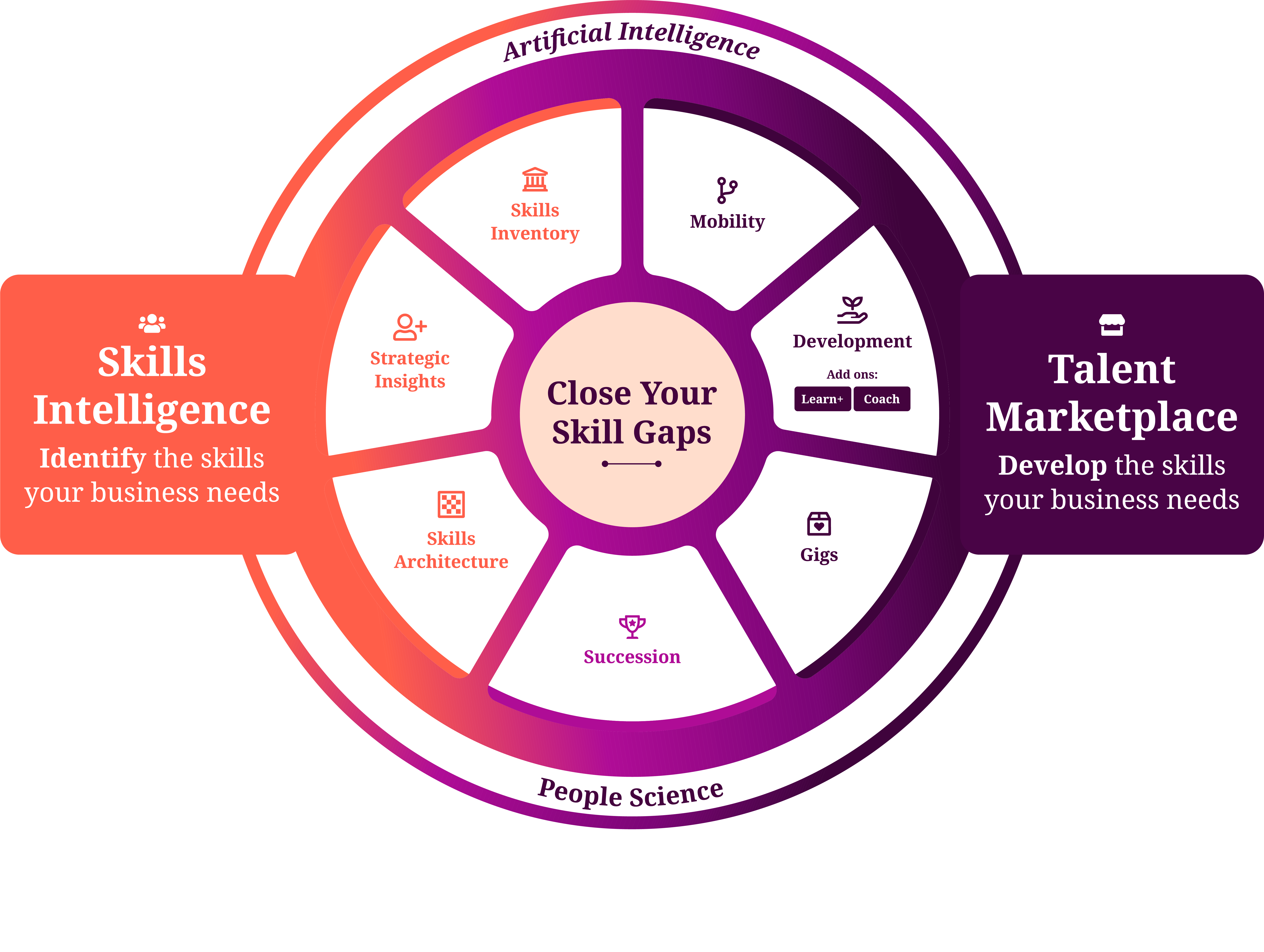
The platform creates a “career DNA” for each employee, a multidimensional profile that factors in aspirations, values, and agility alongside verified skills. This profile drives matching across internal roles, gig projects, mentorships, and learning.
-
Strengths: Thousands of skills in a three-dimensional ontology with proficiency levels and development actions. Bias-tested, explainable AI. Career Advisor Agent for agentic career guidance. Available in 13 languages. Trane Technologies launched globally to 20,000 employees in two weeks.
- Best for: Organizations that prioritize career development and ethical AI alongside skills matching. Particularly strong in financial services, healthcare, and manufacturing.
- Customer outcome: KeyBank saw 72% of users regularly returning to the platform, with 9,800+ skills assessed across the workforce. At UCI, a customer service representative discovered and transitioned into a CRM role after the platform identified the required skills and development path.
Gloat
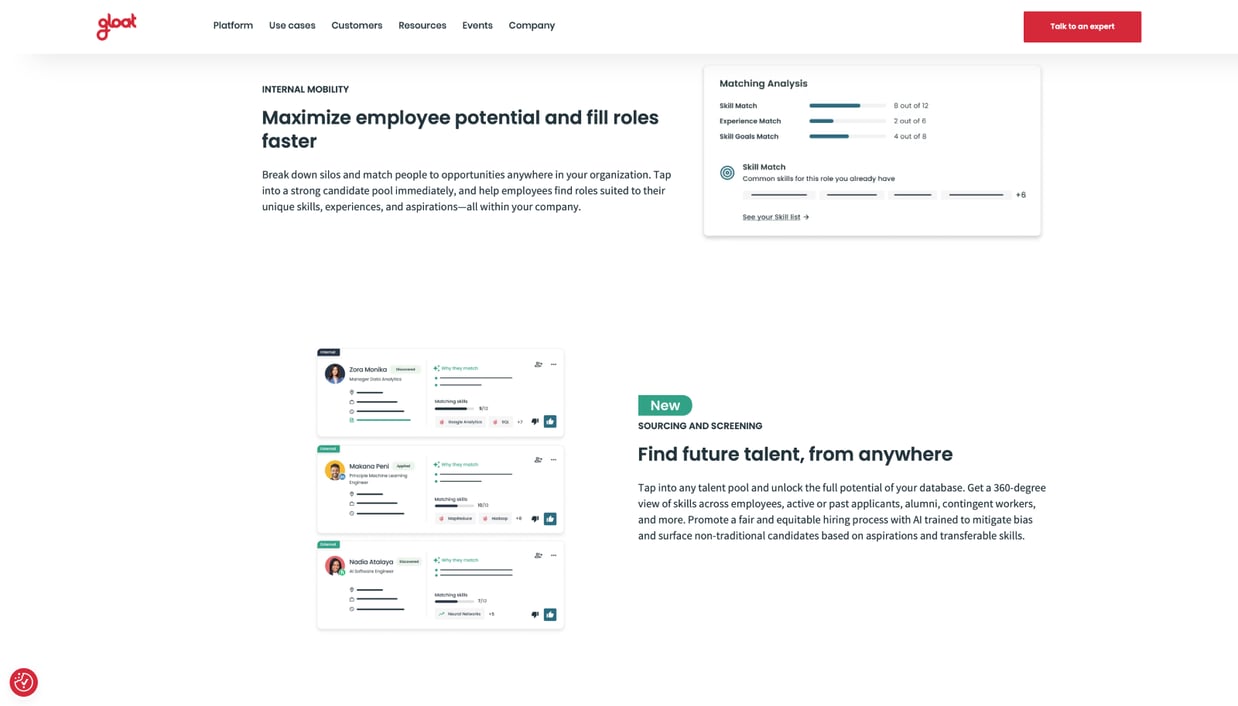
Gloat offers a talent marketplace for enterprise organizations. Its skills ontology is AI-generated and updates based on market data. Gloat integrates with Workday, SAP SuccessFactors, and Oracle HCM.
-
Strengths: Workforce planning tools. Workday and SAP integrations. Microsoft Teams integration for in-flow access.
-
Limitations: Steep learning curve reported by G2 reviewers. Skills ontology is fully AI-generated, with no human curation layer for behavioral competencies or soft skills. Enterprise-only pricing with limited mid-market accessibility.
-
Best for: Organizations running Workday or SAP that want a marketplace with workforce planning features.
Eightfold
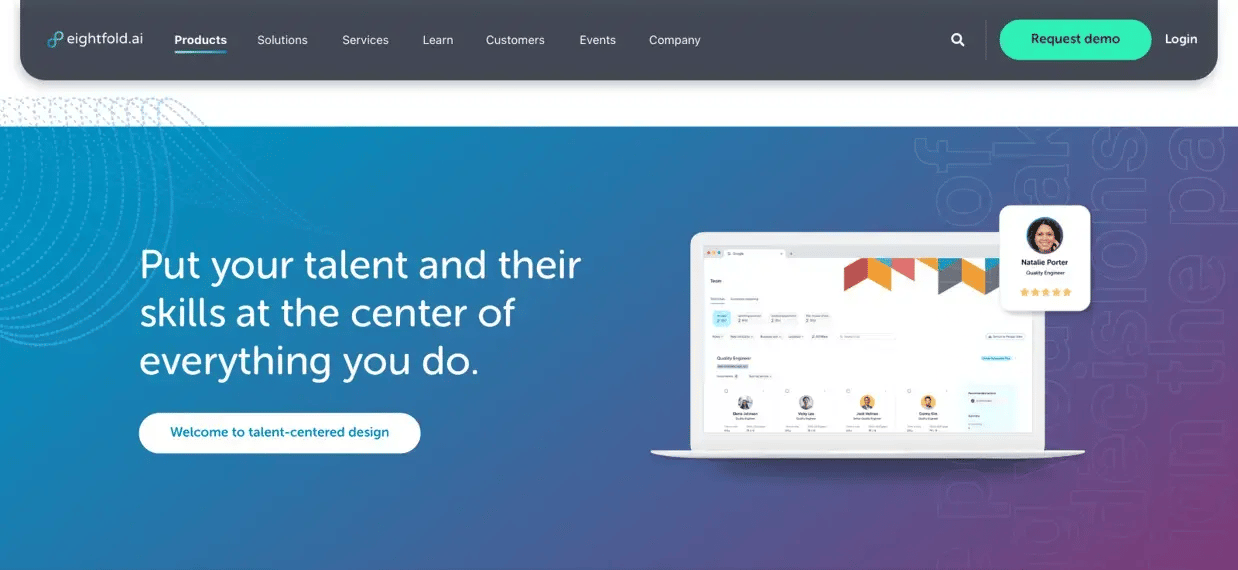
Eightfold uses machine learning to infer skills from employee data and predict potential career moves. The platform covers both external hiring and internal mobility on the same infrastructure.
-
Strengths: Combined external hiring and internal mobility on one platform. AI-inferred skills that reduce manual employee input. Project Marketplace for internal gigs.
-
Limitations: AI decision-making is difficult to audit, which creates challenges in regulated industries. Effectiveness depends heavily on having clean, mature data. Implementation timelines tend to run long. Skills inference lacks the human validation layer needed for nuanced competencies.
-
Best for: Organizations that want recruitment and internal mobility on a single platform and have the data maturity to support AI-inferred skills.
Cornerstone OnDemand
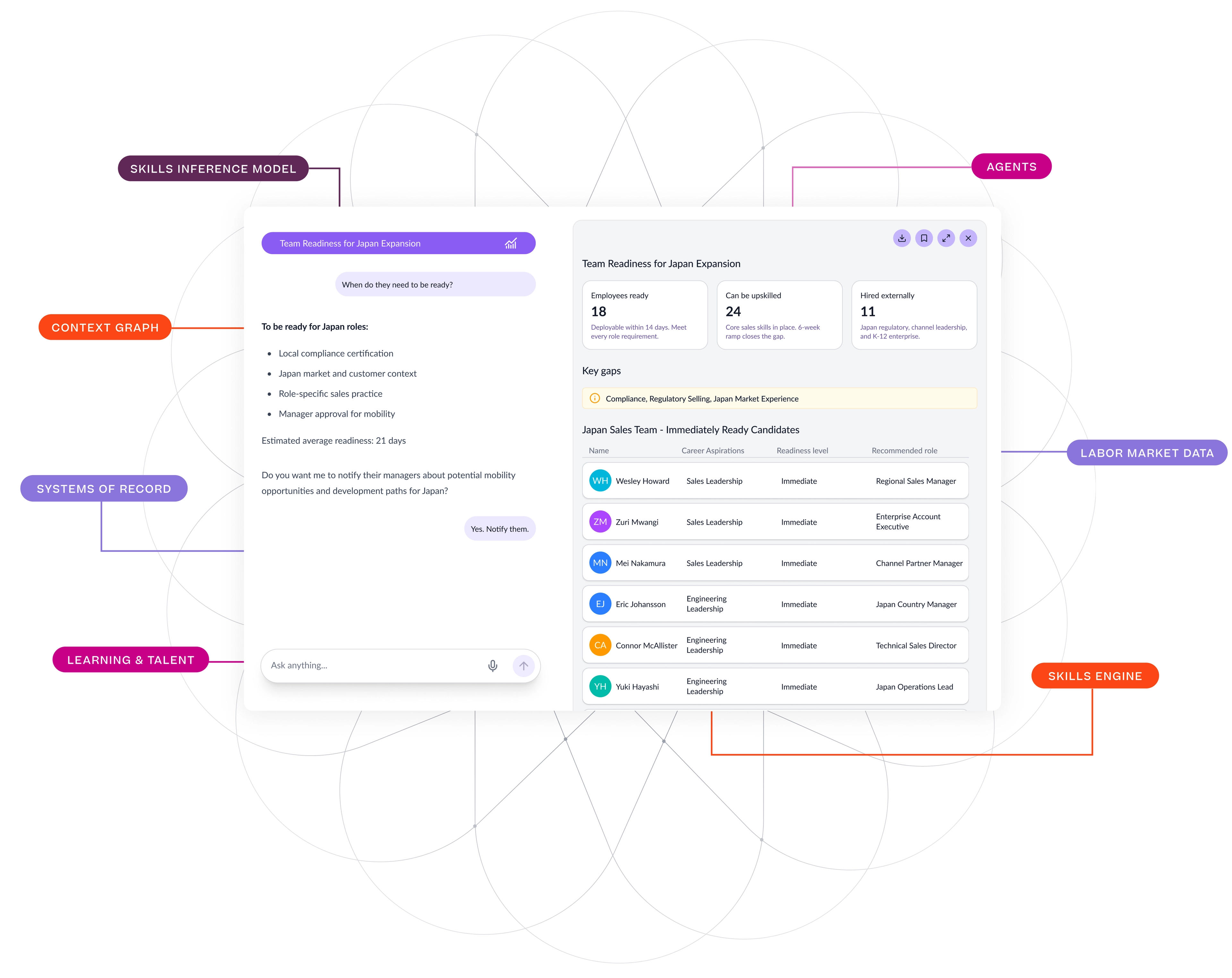
Cornerstone offers a talent marketplace as one module within a broader learning and talent suite. For organizations already running Cornerstone’s LMS, the marketplace adds internal mobility without a new vendor relationship.
-
Strengths: Integration with Cornerstone’s learning ecosystem. Broad language support.
-
Limitations: Marketplace is a module within a suite, with less specialization than purpose-built platforms. Skills ontology and career pathing lack the depth of dedicated solutions. No people science foundation behind the matching methodology. Limited ability to stand alone outside the Cornerstone ecosystem. - Best for: Organizations already invested in Cornerstone that want to add mobility without adding vendors.
Phenom
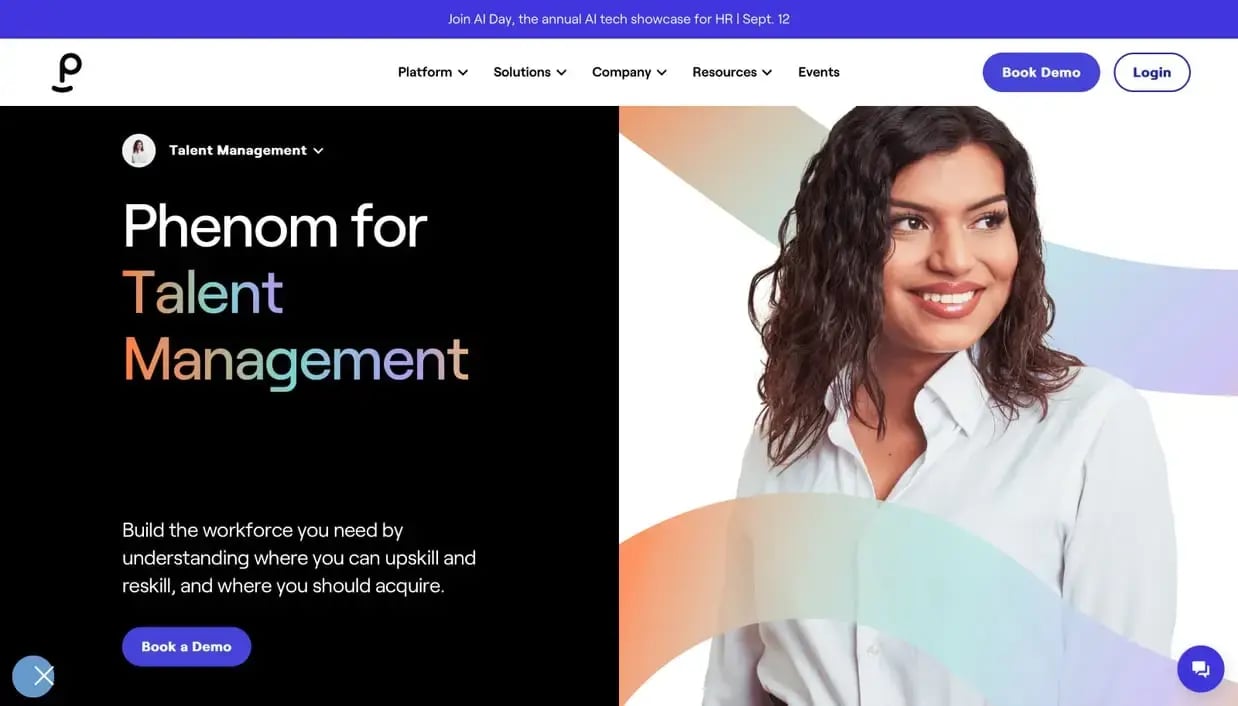
Phenom bundles recruitment, employer branding, and an internal marketplace into a single platform. Its talent marketplace includes gigs, mentorship matching, and career pathing alongside its hiring tools.
-
Strengths: Single vendor for hiring and internal mobility. Skills inference from job history. Employer branding tools included.
-
Limitations: Breadth across the talent lifecycle means less depth in any single area, including skills ontology and career pathing. Significant implementation resources required. Marketplace is one piece of a larger suite rather than the core product.
-
Best for: Large organizations with high-volume hiring needs that want hiring and internal mobility from one vendor.
Workday Skills Cloud
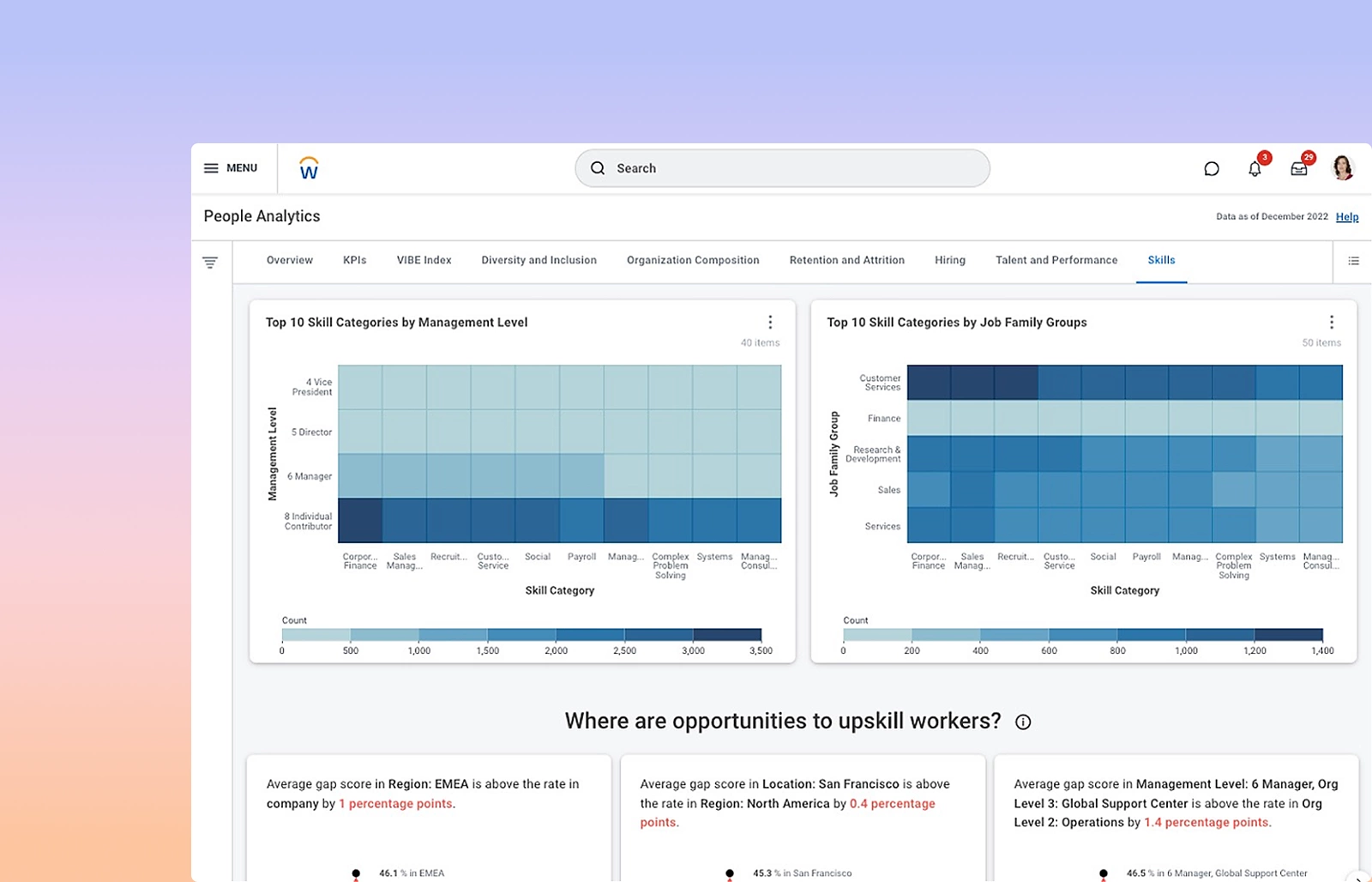
Workday Skills Cloud is the native skills layer within Workday HCM. For organizations already running Workday, it avoids the integration work that a standalone marketplace requires. Skills data lives in the same system that manages headcount, compensation, and performance.
-
Strengths: No separate integration project for Workday customers. Skills data connected to workforce planning.
-
Limitations: Marketplace functionality is significantly narrower than dedicated platforms. Skills inference quality depends entirely on the quality of existing Workday data. Limited career pathing depth. No I/O psychology or people science foundation behind the skills framework.
-
Best for: Organizations fully committed to Workday that want basic skills capabilities without adding another vendor.
Beamery
Beamery spans sourcing, CRM, and internal mobility. Its talent graph connects candidate and employee data across recruiting and internal matching.
-
Strengths: CRM and talent marketing capabilities. Unified candidate and employee data. Workday and SAP integrations.
-
Limitations: Internal marketplace is an extension of the talent acquisition platform rather than a dedicated product. Less depth in career pathing, skills ontology, and employee-facing experiences than purpose-built marketplaces.
-
Best for: Organizations whose primary challenge is talent acquisition and who want basic internal mobility on the same platform.
Neobrain
Neobrain is a European-headquartered platform that combines AI-driven skills matching with strategic workforce planning. Its GDPR-native positioning makes it a natural fit for organizations with significant EU operations.
-
Strengths: GDPR compliance built into architecture. Strategic workforce planning alongside marketplace. AI-driven ontology.
-
Limitations: Limited market presence outside Europe. Fewer published case studies than other platforms on this list.
-
Best for: European-headquartered organizations or those with significant EU workforce requirements.
How to evaluate a talent marketplace for your organization
Before you shortlist
What’s your HRIS?: If you run Workday, evaluate Skills Cloud first to understand what it covers natively before adding a dedicated platform. If you run SAP or Oracle, that fact alone determines which platforms integrate cleanly and which require custom work.
What problem are you solving first?: Retention, skills gaps, workforce agility, career development, or all four? Platforms that excel at skills matching may lack depth in career pathing. Platforms built around career development may lack the workforce planning tools your CHRO needs for board-level conversations.
What’s your skills data maturity?: Organizations with clean, structured skills data can extract value from any platform on this list. Organizations starting from scratch need a platform with its own ontology and architecture, which narrows the field considerably.
What to test in demos
Ask to see how the platform handles a lateral career move for a non-obvious candidate. You want to see someone whose skills suggest a fit that their job title wouldn’t reveal. This test separates platforms that match on titles from platforms that match on capabilities.
Ask how skills are validated. Self-reported skills drive adoption because employees feel ownership. AI-inferred skills improve accuracy because they reduce manual input. Manager-attested skills add credibility but create bottlenecks. You should understand which methods your platform uses by default and whether they can be combined.
Ask about bias testing methodology. Every platform claims ethical AI. Ask who tests for bias, how often, and what methodology they follow. Fuel50’s approach involves I/O psychologists who design fairness testing protocols, a level of rigor that goes beyond algorithmic checks.
What determines whether it works
Adoption is culture change. Fuel50’s research across 80+ enterprise deployments consistently shows that intrinsic motivation drives sustained engagement. Mandated participation generates activity without genuine usage. The organizations that sustain adoption answer “what’s in it for me?” at the individual level in ways that feel concrete rather than aspirational.
The role of agentic AI in talent marketplaces
First-generation talent marketplaces waited for employees to browse. The next generation acts. Agentic AI in this context means AI that initiates career conversations, coaches employees through skill gaps, and takes governed action without requiring employees or managers to navigate a platform.
Fuel50’s Career Advisor Agent delivers explainable, bias-tested career guidance grounded in people science. It is one of the few agentic capabilities in this category that is live in production today. If you’re evaluating talent marketplace software, ask each vendor whether their agentic capabilities are shipping or on a roadmap. The difference between a working agent and a planned one is measured in years.